Hydrochloric Acid → Methyl 2-[(morpholin-4-yl)methyl]benzoate
Reaction equation

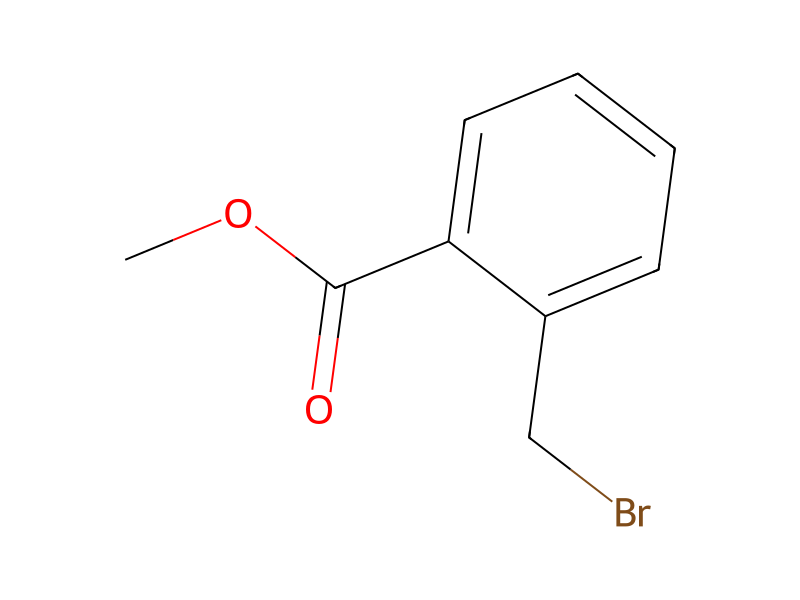
[CH3:1][O:2][C:3](=[O:12])[C:4]1[CH:9]=[CH:8][CH:7]=[CH:6][C:5]=1[CH2:10]Br.[NH:13]1[CH2:18][CH2:17][O:16][CH2:15][CH2:14]1.Cl>CN(C=O)C>[CH3:1][O:2][C:3](=[O:12])[C:4]1[CH:9]=[CH:8][CH:7]=[CH:6][C:5]=1[CH2:10][N:13]1[CH2:18][CH2:17][O:16][CH2:15][CH2:14]1Participants
Reactant 3


Product 1

Reagents, catalysts & solvents 1

Procedure
A solution of N-bromosuccinimide, dibromomethane (3.56 g, 20 mmol) and methyl-2-methylbenzoate (3.04 g, 20 mmol) in 30 mL CHCl3 was refluxed for 4 h. The solvent was evaporated and the residue was purified by column chromatography, with EtOAc:hexanes, 1:5, as eluant, yielding (3.496 g, 76%) of 2-bromomethyl-benzoic acid methyl ester. A solution of 2-bromomethyl-benzoic acid methyl ester (368 mg, 2 mmol) and morpholine (174 mg, 2.0 mmol) in 8 mL DMF with 1 mL HCl (2 N) was refluxed overnight. The solvent was evaporated in vacuo and the residue was purified by column chromatography with EtOAc:hexanes, 1:4, yielding (180 mg, 38%) 2-(morpholin-4-ylmethyl)-benzoic acid methyl ester. The title compound was prepared from 2-(morpholin-4-ylmethyl)-benzoic acid methyl ester, hydrazine and then 3-trifluoromethyl-benzaldehyde in two steps by procedures similar to Example 29. 1H NMR (CDCl3): 8.46 (s, 1H), 8.02 (m, 2H), 7.96 (d, J=7.8 Hz, 1H), 7.45 (d, J=7.8 Hz, 1H), 7.54 (d, J=7.8 Hz, 1H), 7.45 (m, 2H), 7.22 (m, 1H), 3.82 (t, J=4.8 Hz, 4H), 2.64 (t, J=4.8 Hz, 4H).
Workup
- customThe solvent was evaporated in vacuo
- customthe residue was purified by column chromatography with EtOAc
Sources & evidence
- ORD record
- ord-61772f1d9878452a9dab16a8c43c752c
- Source dataset
- uspto-grants-2006_07
- Patent number
- US07074813B2
Reaction notes
Loading…