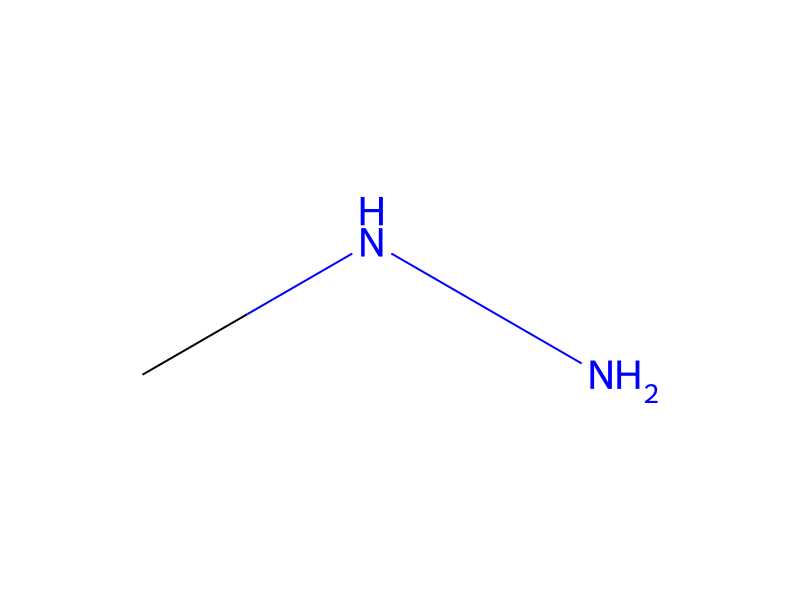
Methylhydrazine → 2,5-dimethoxythiobenzoic acid N-methylhydrazide
Reaction equation

C1CCC(N=C=NC2CCCCC2)CC1.[CH3:16][O:17][C:18]1[CH:26]=[CH:25][C:24]([O:27][CH3:28])=[CH:23][C:19]=1[C:20](O)=O.[CH3:29][NH:30][NH2:31].COC1C=CC(P2(SP(C3C=CC(OC)=CC=3)(=S)S2)=[S:41])=CC=1>CN(C1C=CN=CC=1)C.C(Cl)Cl.C(OCC)(=O)C>[CH3:29][N:30]([C:20](=[S:41])[C:19]1[CH:23]=[C:24]([O:27][CH3:28])[CH:25]=[CH:26][C:18]=1[O:17][CH3:16])[NH2:31]Participants
Reactant 4



Product 1

Reagents, catalysts & solvents 3



Procedure
DCC (4.5 g, 21.8 mmol) was added in one portion to a solution of 2,5-dimethoxybenzoic acid (3.6 g, 20 mol), methylhydrazine (1.2 ml, 23 mmol) and DMAP (30 mg, cat.) in CH2Cl2(60 ml) cooled in an ice bath. The reaction mixture was stirred overnight at room temperature. The slurry was cooled at −20° C. for 1 h and filtered. The CH2Cl2 solution was evaporated and the residue was dried in vacuum. The resulting crude product was dissolved in toluene (50 ml). To this solution was added Lawesson's reagent (5.8 g, 14 mmol). The mixture was refluxed for 40 min, cooled to room temperature, and directly subjected to silica gel column chromatography (eluent: 25% to 35% ethyl acetate in hexanes) to give the 2,5-dimethoxythiobenzoic acid N-methylhydrazide (3.7 g, yield: 82%) as off-white solid. 1H NMR (300 MHz, CDCl3): δ 6.88–6.80 (m, 3H), 5.46 (s, 2H), 3.84(s, 3H), 3.82 (s, 3H), 3.28(s, 3H).
Workup
- temperaturecooled in an ice bath
- temperatureThe slurry was cooled at −20° C. for 1 h
- filtrationfiltered
- customThe CH2Cl2 solution was evaporated
- customthe residue was dried in vacuum
- dissolutionThe resulting crude product was dissolved in toluene (50 ml)
- temperatureThe mixture was refluxed for 40 min
- temperaturecooled to room temperature
Sources & evidence
- ORD record
- ord-917ca00bfa7848439af464b8b18dd5bb
- Source dataset
- uspto-grants-2006_07
- Patent number
- US07074952B2
Reaction notes
Loading…