Hydrochloric Acid → HCID 178429412, compound
Reaction equation

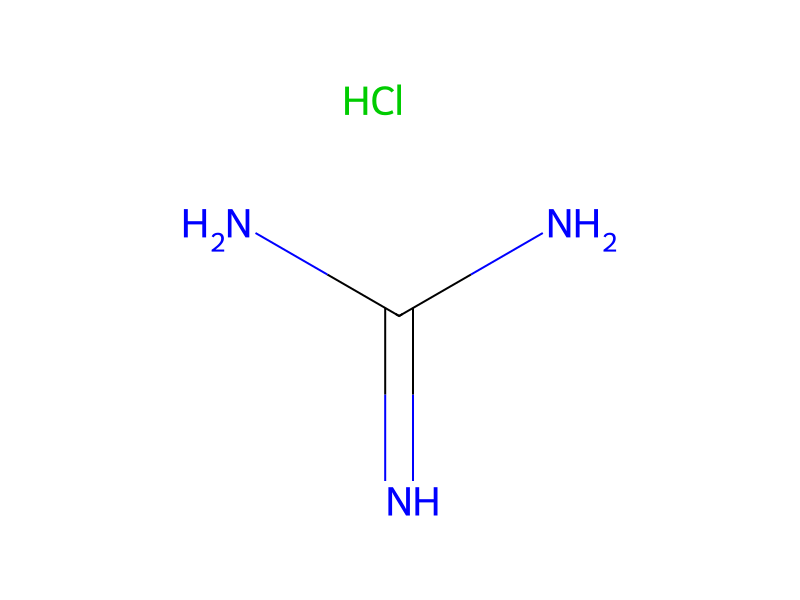
C[O-].[Na+].[ClH:4].[NH2:5][C:6]([NH2:8])=[NH:7].[Cl:9][C:10]([C:12]1[C:16]([CH3:17])=[C:15]([CH3:18])[N:14]([C:19]2[C:28]3[C:23](=[CH:24][CH:25]=[CH:26][CH:27]=3)[N:22]=[CH:21][CH:20]=2)[CH:13]=1)=[O:11].Cl>COCCOC.C(Cl)(Cl)Cl.C(O)C.O1CCOCC1.CO>[ClH:9].[ClH:4].[NH:7]([C:10]([C:12]1[C:16]([CH3:17])=[C:15]([CH3:18])[N:14]([C:19]2[C:28]3[C:23](=[CH:24][CH:25]=[CH:26][CH:27]=3)[N:22]=[CH:21][CH:20]=2)[CH:13]=1)=[O:11])[C:6]([NH2:8])=[NH:5]Participants
Reactant 4



Product 1

Reagents, catalysts & solvents 5





Conditions
- Temperature
- 20 °C
Procedure
1.78 g (33 mmol) of sodium methoxide are added at a temperature in the region of 20° C. under an argon atmosphere to 20 mL of methanol. After complete dissolution, 3.34 g (35 mmol) of guanidine hydrochloride are added. After stirring at a temperature in the region of 20° C. for 0.5 hour, the reaction mixture is concentrated to dryness under reduced pressure (2.7 kPa) to give a residue which is suspended in 25 mL of 1,2-dimethoxyethane and then again concentrated to dryness. The residue is suspended in a mixture of 75 mL of tetrahydrofuran and 50 mL of dichloromethane at a temperature in the region of 20° C. under an argon atmosphere and then 1.17 g (4.1 mmol) of 3-chlorocarbonyl-4,5-dimethyl-1-(quinol-4-yl)-1H-pyrrole, dissolved in 25 mL of chloroform, are added thereto. After stirring at a temperature in the region of 20° C. for 18 hours, the reaction mixture is concentrated to dryness under reduced pressure (2.7 kPa) to give a residue which is triturated in 100 mL of water. After filtering, a gum is obtained, which gum is triturated in 50 mL of methanol and filtered. The solution obtained is partially concentrated to a volume of 5 to 10 mL and then purified by silica gel chromatography [eluent: chloroform/methanol (90/10 and then 70/30 by volume)]. After concentrating the fractions under reduced pressure, an oil is obtained, which oil is dissolved in ethanol and to which is added 4 mL of a 5.3N solution of hydrochloric acid in dioxane. The solution obtained is concentrated to dryness under reduced pressure (2.7 kPa) to give a residue which is triturated in a mixture of isopropanol and isopropyl acetate. 0.96 g of 3-guanidinocarbonyl-4,5-dimethyl-1-(quinol-4-yl)-1H-pyrrole dihydrochloride is thus obtained in the form of a yellow solid which decomposes at a temperature of greater than 260° C. Mass spectrum (EI): m/e 307 (M+) m/e 248. IR spectrum (KBr): 3371, 3103, 2622, 1694, 1599, 1495, 1423, 1308, 1251, 1194, 1093 and 754 cm−1.
Workup
- additionare added
- concentrationthe reaction mixture is concentrated to dryness under reduced pressure (2.7 kPa)
- customto give a residue which
- concentrationagain concentrated to dryness
- additionThe residue is suspended in a mixture of 75 mL of tetrahydrofuran and 50 mL of dichloromethane at a temperature in the region of 20° C. under an argon atmosphere
- additionare added
- stirringAfter stirring at a temperature in the region of 20° C. for 18 hours
- concentrationthe reaction mixture is concentrated to dryness under reduced pressure (2.7 kPa)
- customto give a residue which
- customis triturated in 100 mL of water
- filtrationAfter filtering
- customa gum is obtained
- customwhich gum is triturated in 50 mL of methanol
- filtrationfiltered
- customThe solution obtained
- concentrationis partially concentrated to a volume of 5 to 10 mL
- custompurified by silica gel chromatography [eluent
- concentrationAfter concentrating the fractions under reduced pressure
- customan oil is obtained
- customThe solution obtained
- concentrationis concentrated to dryness under reduced pressure (2.7 kPa)
- customto give a residue which
- customis triturated in a mixture of isopropanol and isopropyl acetate
Sources & evidence
- ORD record
- ord-d0bdaf28d9484854bfe56b4706d69540
- Source dataset
- uspto-grants-2006_07
- Patent number
- US07078414B2
Reaction notes
Loading…