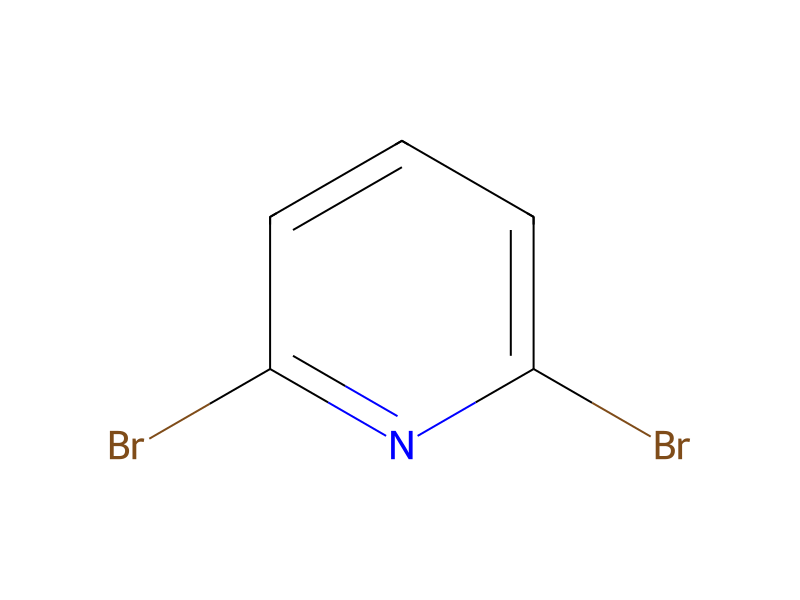
2,6-Dibromopyridine → 6-Bromo-2,3'-bipyridine
Reaction equation

C([Sn](CCCC)(CCCC)[C:6]1[CH:7]=[N:8][CH:9]=[CH:10][CH:11]=1)CCC.[Br:20][C:21]1[CH:26]=[CH:25][CH:24]=[C:23](Br)[N:22]=1>O1CCCC1.C1C=CC([P]([Pd]([P](C2C=CC=CC=2)(C2C=CC=CC=2)C2C=CC=CC=2)([P](C2C=CC=CC=2)(C2C=CC=CC=2)C2C=CC=CC=2)[P](C2C=CC=CC=2)(C2C=CC=CC=2)C2C=CC=CC=2)(C2C=CC=CC=2)C2C=CC=CC=2)=CC=1>[CH3:9][CH2:10][CH2:11][CH:6]([CH3:7])[CH3:21].[Br:20][C:21]1[N:22]=[C:23]([C:6]2[CH:7]=[N:8][CH:9]=[CH:10][CH:11]=2)[CH:24]=[CH:25][CH:26]=1Participants




Procedure
3-Tributylstannylpyridine (3.3 g, 9.0 mmol) was added to a degassed solution of 2,6-dibromopyridine (2.0 g, 8.3 mmol) and tetrakis(triphenylphosphine)palladium(0) (0.48 g, 5 mol %) in dry tetrahydrofuran (30 ml), stirred under an atmosphere of nitrogen and heated to reflux for 48 h. After cooling to ambient temperature, solvent was removed in vacuo, the residue dissolved in dichloromethane and purified by chromatography on silica gel eluting with dichloromethane on a gradient of methanol (0-4%). Trituration with isohexane gave 6-bromo-2,3′-bipyridine (0.4 g) as a solid: δH (400 MHz, CDCl3) 7.42 (1H, dd, J 8 and 8), 7.49 (1H, d, J 7), 7.65 (1H, dd, J 7 and 7), 7.73 (1H, d, J 7), 8.35 (1H, m), 8.68 (1H, m), 9.16 (1H, s); m/z (ES+) 235/236 (M++H).
Workup
- temperatureheated
- temperatureto reflux for 48 h
- customsolvent was removed in vacuo
- dissolutionthe residue dissolved in dichloromethane
- custompurified by chromatography on silica gel eluting with dichloromethane on a gradient of methanol (0-4%)
Sources & evidence
- ORD record
- ord-2f3b883f4f6c42528ed8e270b86375b3
- Source dataset
- uspto-grants-2006_04
- Patent number
- US07030128B2
Reaction notes
Loading…