Water → ethyl 2-chloro-4-(3-fluoro-4-(1H-imidazol-1-yl)phenylamino)pyrimidine-5-carboxylate
Reaction equation

[Cl:1][C:2]1[N:7]=[C:6](Cl)[C:5]([C:9]([O:11][CH2:12][CH3:13])=[O:10])=[CH:4][N:3]=1.[F:14][C:15]1[CH:16]=[C:17]([NH2:26])[CH:18]=[CH:19][C:20]=1[N:21]1[CH:25]=[CH:24][N:23]=[CH:22]1.CCN(C(C)C)C(C)C.O>CC#N.CCOC(C)=O>[Cl:1][C:2]1[N:7]=[C:6]([NH:26][C:17]2[CH:18]=[CH:19][C:20]([N:21]3[CH:25]=[CH:24][N:23]=[CH:22]3)=[C:15]([F:14])[CH:16]=2)[C:5]([C:9]([O:11][CH2:12][CH3:13])=[O:10])=[CH:4][N:3]=1Participants
7
Reactant 4


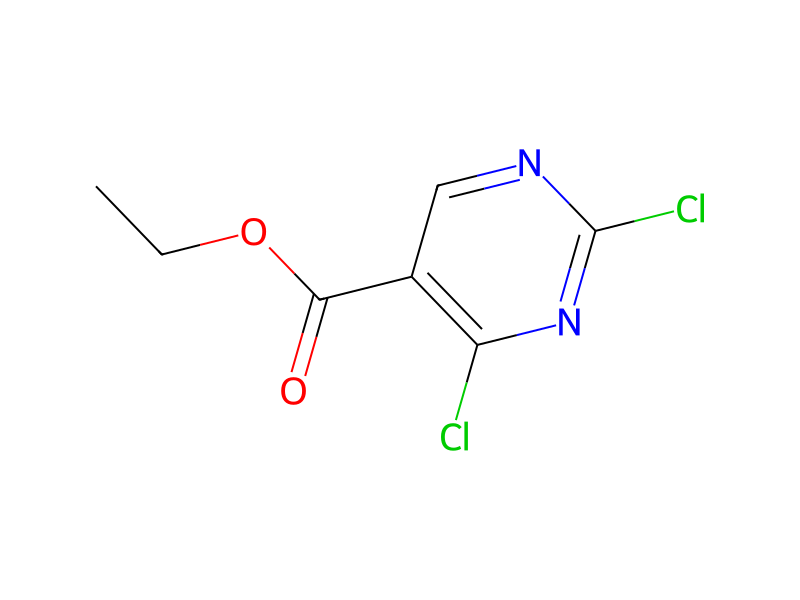

Product 1

Reagents, catalysts & solvents 2


Procedure
To a solution of ethyl 2,4-dichloropyrimidine-5-carboxylate (280 mg, 1.27 mmol) and 3-fluoro-4-(1H-imidazol-1-yl)benzenamine (230 mg, 1.30 mmol) in CH3CN (8 mL) at room temperature, DIEA (0.442 mL, 2.54 mmol) was added. The mixture was stirred at room temperature overnight. Water and EtOAc were added. The organic phase was separated, dried over Na2SO4, concentrated in vacuo to give ethyl 2-chloro-4-(3-fluoro-4-(1H-imidazol-1-yl)phenylamino)pyrimidine-5-carboxylate as a solid (383 mg). MS 362.4 and 364.3 (M+H, Cl pattern)
Workup
- customThe organic phase was separated
- dry with materialdried over Na2SO4
- concentrationconcentrated in vacuo
Sources & evidence
- ORD record
- ord-d84644dc188b43c2b270383bfe2474ec
- Source dataset
- uspto-grants-2013_01
- Patent number
- US08349860B2
Reaction notes
Loading…