Benzene → 4,6-Dichloro-5-(1,3-dioxolan-2-yl)pyrimidine
Reaction equation

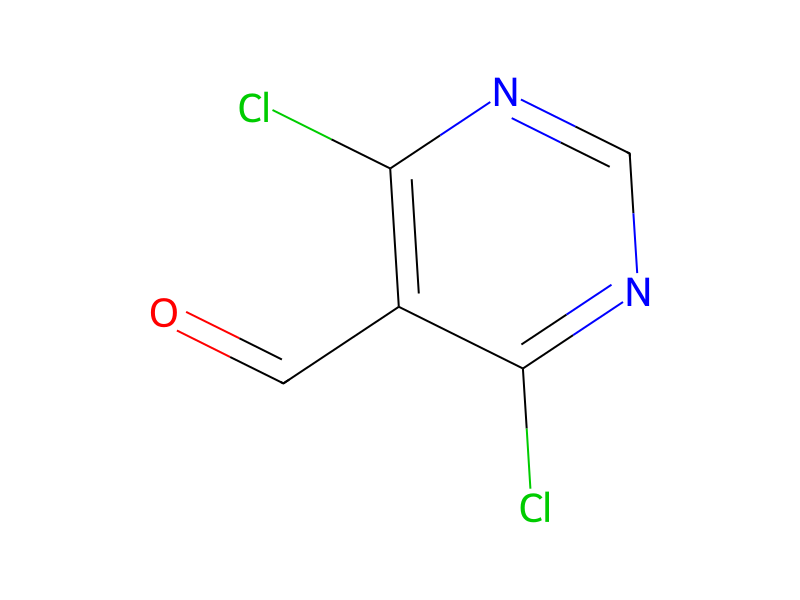
[CH:1]1[CH:6]=CC=CC=1.[Cl:7][C:8]1[C:13]([CH:14]=[O:15])=[C:12]([Cl:16])[N:11]=[CH:10][N:9]=1.O.C1(C)C=CC(S(O)(=O)=[O:25])=CC=1.C([O-])(O)=O.[Na+]>O.C(O)CO>[Cl:7][C:8]1[C:13]([CH:14]2[O:25][CH2:1][CH2:6][O:15]2)=[C:12]([Cl:16])[N:11]=[CH:10][N:9]=1Participants






Procedure
A mixture of 300 ml benzene and 8.2 ml ethylene glycol was heated to reflux and 100 ml solution was distilled off. To the hot solution was added 4,6-dichloro-5-pyrimidinecarbaldehyde (Bionet, 8.6 g, 48.6 mmol) and p-toluenesulfonic acid monohydrate (Aldrich, 150 mg, 0.8 mmol). The mixture was returned to reflux and water was removed via Dean-Stark trap over 3 h. After cooling, the solvents were removed under vacuum to yield a dry, yellow solid. The solids were slurried in H2O (30 ml)/saturated NaHCO3 solution (30 ml). White solid 107 was filtered off and dried under vacuum (8.8 g, 82%). Compound 107: mp 108-110° C.; MS (ES+ calculated: 221.04; found: 221/223 M+H). 1H NMR (400 MHz, DMSO-d6) δ 8.95 (s, 1H), 6.26 (s, 1H), 4.23 (m, 2H), 4.05 (m, 2H).
Workup
- temperaturewas heated
- temperatureto reflux
- distillation100 ml solution was distilled off
- temperatureto reflux
- customwater was removed via Dean-Stark trap over 3 h
- temperatureAfter cooling
- customthe solvents were removed under vacuum
- customto yield a dry, yellow solid
- filtrationWhite solid 107 was filtered off
- customdried under vacuum (8.8 g, 82%)
Sources & evidence
- ORD record
- ord-3883ee95e7354900909544e877e865d6
- Source dataset
- uspto-grants-2013_01
- Patent number
- US08354414B2
Reaction notes
Loading…