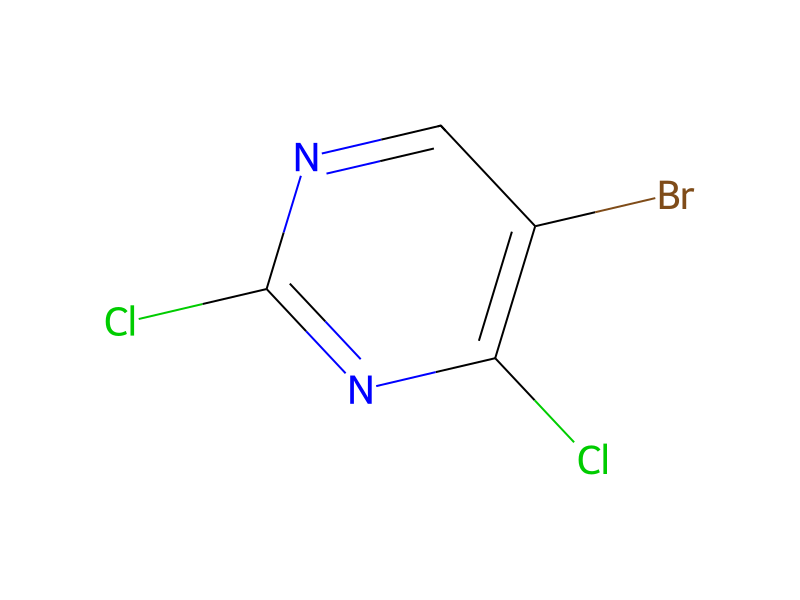
5-Bromo-2,4-dichloropyrimidine → (6-Bromo-pyridin-2-yl)-(2,4-dichloro-pyrimidin-5-yl)-methanol
Reaction equation

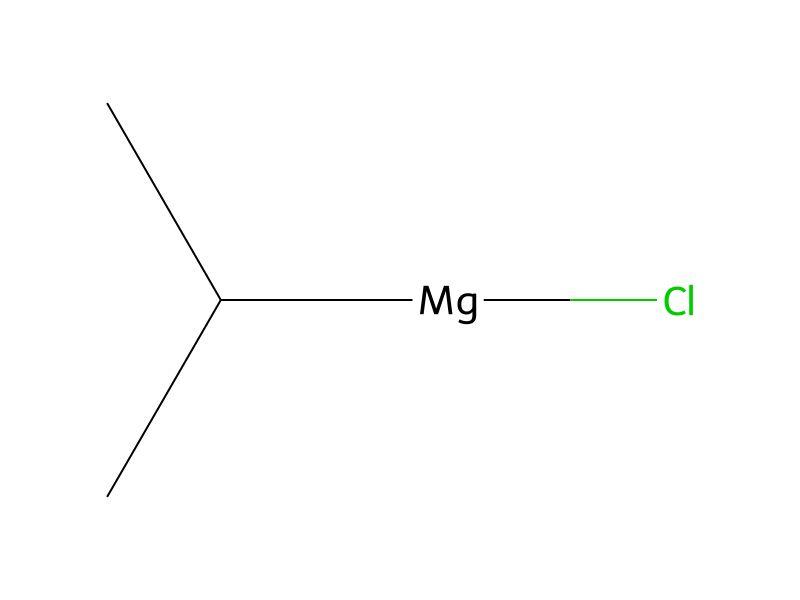
Br[C:2]1[C:3]([Cl:9])=[N:4][C:5]([Cl:8])=[N:6][CH:7]=1.C([Mg]Cl)(C)C.[Br:15][C:16]1[N:21]=[C:20]([CH:22]=[O:23])[CH:19]=[CH:18][CH:17]=1>C1COCC1>[Br:15][C:16]1[N:21]=[C:20]([CH:22]([C:2]2[C:3]([Cl:9])=[N:4][C:5]([Cl:8])=[N:6][CH:7]=2)[OH:23])[CH:19]=[CH:18][CH:17]=1Participants



Conditions
- Temperature
- -30 °C
Procedure
To a stirred solution of 5-bromo-2,4-dichloropyrimidine (11.4 g, 50 mmol) in THF (200 mL) at −30° C., was added dropwise isopropyl magnesium chloride (25 mL, 2 M in THF, 50 mmol) and the mixture was stirred at −30° C. for 20 minutes. Then a solution of 6-bromopicolinaldehyde (9.3 g, 50 mmol) in THF (10 mL) was added and the mixture was warmed to 0° C. and stirred for another 40 minutes. The reaction was quenched by adding saturated aqueous NH4Cl solution and the resulting mixture was extracted with ethyl acetate (3×300 mL). The organic solutions were then washed with brine. The organic phase was dried with anhydrous MgSO4, filtered and concentrated under reduced pressure to give crude (6-bromo-pyridin-2-yl)-(2,4-dichloro-pyrimidin-5-yl)-methanol as a light yellow oil. (Yield 16.1 g)
Workup
- temperaturethe mixture was warmed to 0° C.
- stirringstirred for another 40 minutes
- customThe reaction was quenched
- additionby adding saturated aqueous NH4Cl solution
- extractionthe resulting mixture was extracted with ethyl acetate (3×300 mL)
- washThe organic solutions were then washed with brine
- dry with materialThe organic phase was dried with anhydrous MgSO4
- filtrationfiltered
- concentrationconcentrated under reduced pressure
Sources & evidence
- ORD record
- ord-676bf3c3d6ee45d895758471fa149978
- Source dataset
- uspto-grants-2013_01
- Patent number
- US08362023B2
Reaction notes
Loading…