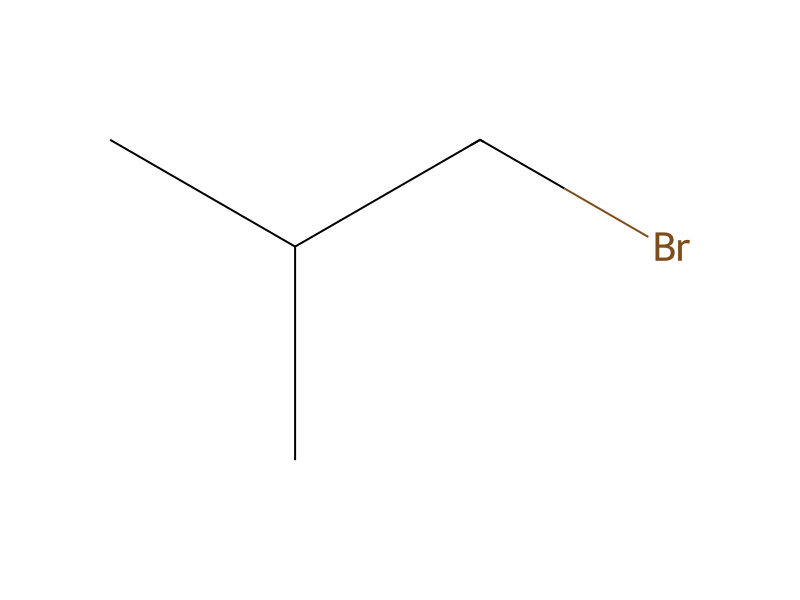
1-Bromo-2-methylpropane → 1-Bromo-4-(2-methylpropoxy)benzene
Reaction equation

[Br:1][C:2]1[CH:7]=[CH:6][C:5]([OH:8])=[CH:4][CH:3]=1.C(=O)([O-])[O-].[K+].[K+].[CH2:15](Br)[CH:16]([CH3:18])[CH3:17]>CC(C)=O.O>[Br:1][C:2]1[CH:7]=[CH:6][C:5]([O:8][CH2:15][CH:16]([CH3:18])[CH3:17])=[CH:4][CH:3]=1Participants
6
Reactant 3


Product 1

Reagents, catalysts & solvents 2


Procedure
4-Bromo-phenol (2 g, 11.6 mmol) is dissolved in acetone (40 mL). Potassium carbonate (8 g, 38.4 mmol) is then added followed by isobutyl bromide (4 g, 29.2 mmol). The reaction is heated to reflux for four days, refilling solvent as necessary. The reaction mixture is diluted with water and extracted with ether, the organic layer is separated and concentrated in vacuo. The residue is dissolved in hexane dried with magnesium sulfate, and filtered through a plug of silica gel. The solvent is removed in vacuo to afford 1.6 g (60% yield) of the title compound as a colorless non-viscous oil. 1H NMR (CDCl3) 1.01 (d, 6H, J=6.56 Hz), 2.05-2.08 (m, 1H), 3.67 (d, 2H, J=6.57 Hz), 6.77 (d, 2H, J=9.09 Hz), 7.36 (d, 2H, J=9.09 Hz).
Workup
- temperatureThe reaction is heated
- temperatureto reflux for four days
- extractionextracted with ether
- customthe organic layer is separated
- concentrationconcentrated in vacuo
- dissolutionThe residue is dissolved in hexane
- dry with materialdried with magnesium sulfate
- filtrationfiltered through a plug of silica gel
- customThe solvent is removed in vacuo
Sources & evidence
- ORD record
- ord-1bbfacf3f50f42a686a514d8176349d2
- Source dataset
- uspto-grants-2013_01
- Patent number
- US08362063B2
Reaction notes
Loading…