Tetrahydrofuran → Methyl 6-methyl-4'-trifluoromethylbiphenyl-2-carboxylate
Reaction equation

FC(F)(F)S(O[C:7]1[C:16]([CH3:17])=[CH:15][CH:14]=[CH:13][C:8]=1[C:9]([O:11][CH3:12])=[O:10])(=O)=O.C(=O)([O-])[O-].[K+].[K+].O1CCCC1.[F:31][C:32]([F:43])([F:42])[C:33]1[CH:38]=[CH:37][C:36](B(O)O)=[CH:35][CH:34]=1>O>[CH3:17][C:16]1[CH:15]=[CH:14][CH:13]=[C:8]([C:9]([O:11][CH3:12])=[O:10])[C:7]=1[C:36]1[CH:37]=[CH:38][C:33]([C:32]([F:43])([F:42])[F:31])=[CH:34][CH:35]=1Participants
Reactant 4


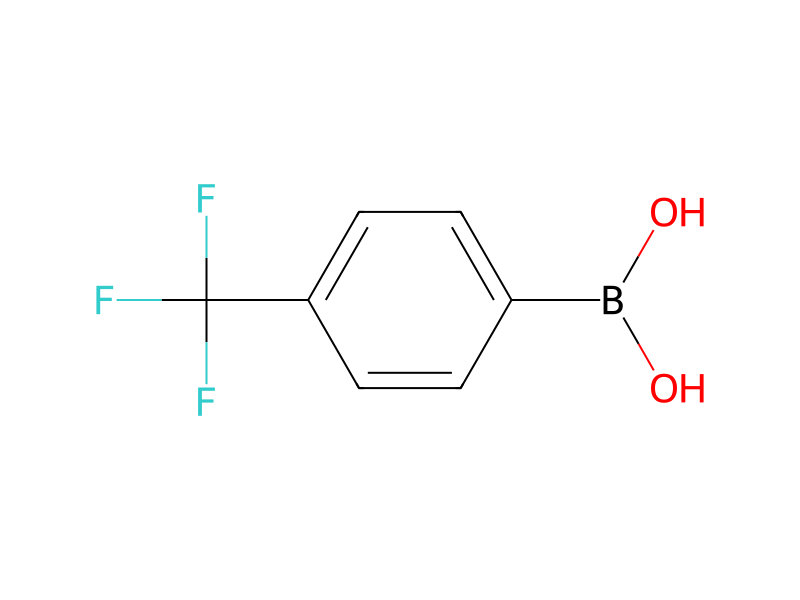

Product 1

Reagents, catalysts & solvents 1

Procedure
To a solution of methyl 2-trifluoromethanesulfonyloxy-3-methylbenzoate (900 g, in toluene), potassium carbonate (629.6 g), tetrahydrofuran (2700 mL) and deionized water (5400 mL) under nitrogen is added tetrakis (triphenylphosphine)palladium (0) (104.6 g). To this is added the above solution of p-trifluoromethylphenylboronic acid and the mixture is heated at reflux for 2 days. The reaction mixture is filtered and evaporated to dryness. The residue is partitioned between water and ethyl acetate. The ethyl acetate layer is separated and evaporated to dryness. The residue is taken up in heptane-ethyl acetate (9:1), the mixture is filtered and the filtrate is evaporated to dryness to give methyl 6-methyl-4′-trifluoromethylbiphenyl-2-carboxylate as an oil.
Workup
- temperaturethe mixture is heated
- temperatureat reflux for 2 days
- filtrationThe reaction mixture is filtered
- customevaporated to dryness
- customThe residue is partitioned between water and ethyl acetate
- customThe ethyl acetate layer is separated
- customevaporated to dryness
- filtrationthe mixture is filtered
- customthe filtrate is evaporated to dryness
Sources & evidence
- ORD record
- ord-a9275b67556e4c20833a95ed92231573
- Source dataset
- uspto-grants-2005_04
- Patent number
- US06878707B2
Reaction notes
Loading…