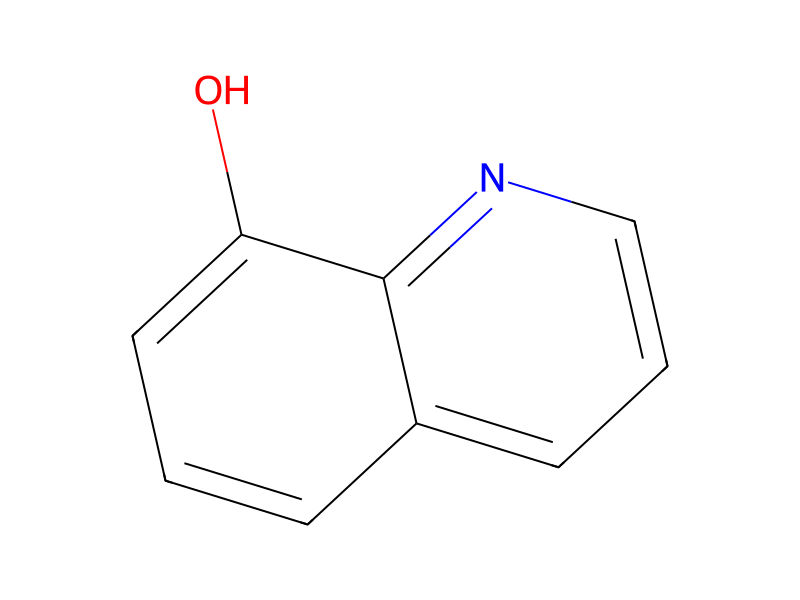
8-Hydroxyquinoline → HCID 69058049, compound
Reaction equation

[NH2:1][C:2]1[CH:9]=[CH:8][C:7](Br)=[CH:6][C:3]=1[C:4]#[N:5].[OH:11][C:12]1[CH:17]=[CH:16][CH:15]=[CH:14][N:13]=1.C(=O)([O-])[O-].[K+].[K+].OC1C=CC=C2C=1N=CC=C2>CS(C)=O.C(Cl)Cl.[Cu]I>[NH2:1][C:2]1[CH:9]=[CH:8][C:7]([N:13]2[CH:14]=[CH:15][CH:16]=[CH:17][C:12]2=[O:11])=[CH:6][C:3]=1[C:4]#[N:5]Participants
8
Reactant 4



Product 1

Reagents, catalysts & solvents 3



Conditions
- Temperature
- 160 °C
Procedure
A suspension of 2-amino-5-bromobenzonitrile (1 g), 2-hydroxypyridine (730 mg), CuI (190 mg), potassium carbonate (770 mg) and 8-hydroxyquinoline (150 mg) in 7 ml DMSO was heated for 1.5 h at 160° C. The reaction mixture was afterwards cooled, diluted with CH2Cl2 and filtered through decalite. The organic phase was extracted with water and brine and purified by chromatography (silica gel, AcOEt/heptane) to yield 2-amino-5-(2-oxo-2H-pyridin-1-yl)-benzonitrile as a yellow solid (120 mg). MH+=212.1
Workup
- temperatureThe reaction mixture was afterwards cooled
- filtrationfiltered through decalite
- extractionThe organic phase was extracted with water and brine
- custompurified by chromatography (silica gel, AcOEt/heptane)
Sources & evidence
- ORD record
- ord-89f981ce876d4d7dbcd9337c878cbf42
- Source dataset
- uspto-grants-2009_10
- Patent number
- US07601752B2
Reaction notes
Loading…