Potassium Carbonate → 5-nitro-1-(2-pyrrolidin-1-ylethyl)-1H-indole
Reaction equation

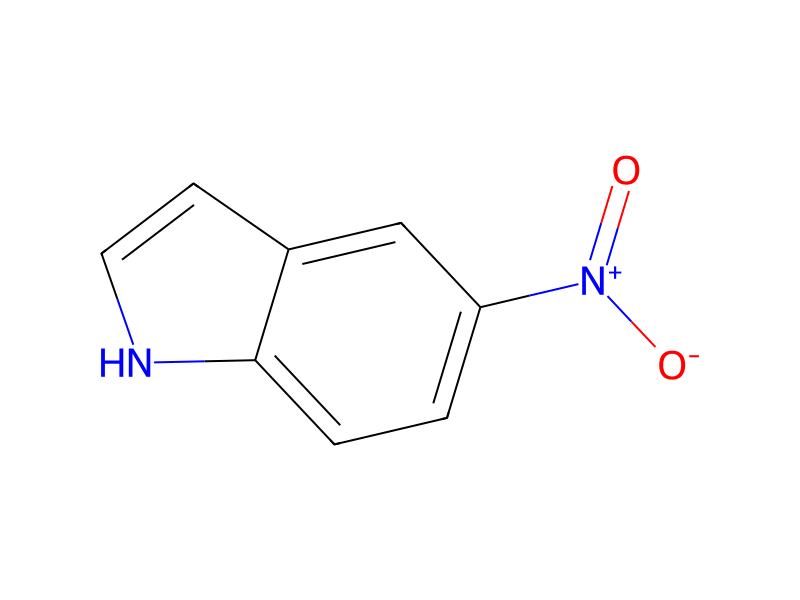
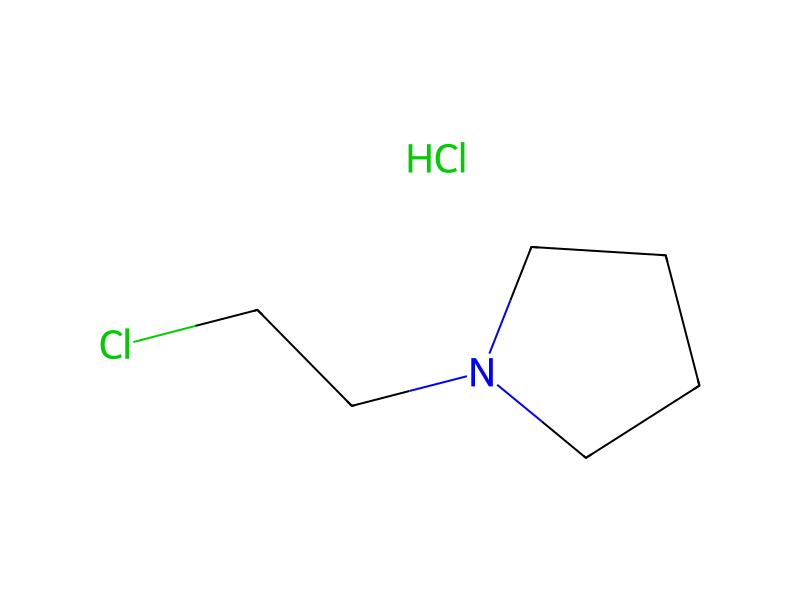
[N+:1]([C:4]1[CH:5]=[C:6]2[C:10](=[CH:11][CH:12]=1)[NH:9][CH:8]=[CH:7]2)([O-:3])=[O:2].Cl.Cl[CH2:15][CH2:16][N:17]1[CH2:21][CH2:20][CH2:19][CH2:18]1.C(=O)([O-])[O-].[K+].[K+]>CN(C=O)C>[N+:1]([C:4]1[CH:5]=[C:6]2[C:10](=[CH:11][CH:12]=1)[N:9]([CH2:15][CH2:16][N:17]1[CH2:21][CH2:20][CH2:19][CH2:18]1)[CH:8]=[CH:7]2)([O-:3])=[O:2]Participants
5
Reactant 3

Product 1

Reagents, catalysts & solvents 1

Procedure
A reaction mixture of 16.2 g (100 mmol) of 5-nitroindole, 35.0 g (206 mmol) of 1-(2-chloroethyl)pyrrolidine hydrochloride, and 51.0 g (369 mmol) of potassium carbonate in 500 mL of DMF is stirred for 48 hours at ambient temperature and then filtered. The filtrate is evaporated down, and the residue is dissolved in dichloromethane and dried over sodium sulfate. The drying agent is filtered off and the filtrate evaporated down. Yield: 25 g (96% of theory); Rf value: 0.65 (silica gel, dichloromethane/methanol/ammonia=9:1:0.1); C14H17N3O2; EII mass spectrum: m/z=260 [M+H]+.
Workup
- filtrationfiltered
- customThe filtrate is evaporated down
- dissolutionthe residue is dissolved in dichloromethane
- dry with materialdried over sodium sulfate
- filtrationThe drying agent is filtered off
- customthe filtrate evaporated down
Sources & evidence
- ORD record
- ord-0365bccdb02e40e68266046c2c878910
- Source dataset
- uspto-grants-2009_10
- Patent number
- US07605176B2
Reaction notes
Loading…