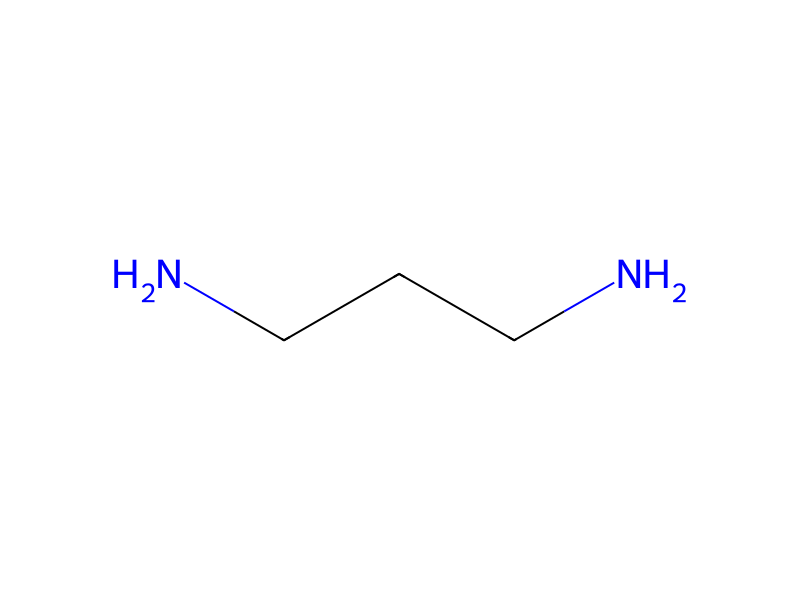
1,3-Propanediamine → N-(3-aminopropyl)-6-chloro-1,2,3,4-tetrahydroacridin-9-amine
Reaction equation

[Cl:1][C:2]1[CH:3]=[C:4]2[C:13](=[CH:14][CH:15]=1)[C:12](Cl)=[C:11]1[C:6]([CH2:7][CH2:8][CH2:9][CH2:10]1)=[N:5]2.[NH2:17][CH2:18][CH2:19][CH2:20][NH2:21].C(O)CCCC.C(=O)(O)[O-].[Na+]>>[Cl:1][C:2]1[CH:3]=[C:4]2[C:13](=[CH:14][CH:15]=1)[C:12]([NH:17][CH2:18][CH2:19][CH2:20][NH2:21])=[C:11]1[C:6]([CH2:7][CH2:8][CH2:9][CH2:10]1)=[N:5]2Participants
5




Procedure
To a sealed tube was charged a mixture of 6,9-dichloro-1,2,3,4-tetrahydroacridine (1.0 g, 3.97 mmoL), 1,3-diaminopropane (1.67 mL, 19.83 mmoL) and 4 mL 1-pentanol. The mixture was heated to 160 degree Celsius for 24 h. After cooled down and saturated sodium bicarbonate was added, the mixture was extracted with dichloromethane three times. The combined extract was dried over sodium sulfate, filtered and concentrated. The resulting residue was purified by column chromatography on silica gel with 10-20% MeOH/CH2Cl2 (1% ammonium hydroxide) to give the desired product as brown oil (1.0 g, 87%).
Workup
- additionTo a sealed tube was charged
- temperatureThe mixture was heated to 160 degree Celsius for 24 h
- temperatureAfter cooled down
- extractionthe mixture was extracted with dichloromethane three times
- extractionThe combined extract
- dry with materialwas dried over sodium sulfate
- filtrationfiltered
- concentrationconcentrated
- customThe resulting residue was purified by column chromatography on silica gel with 10-20% MeOH/CH2Cl2 (1% ammonium hydroxide)
Sources & evidence
- ORD record
- ord-2e3ba6e0ae544488bac4b34d3f5b7733
- Source dataset
- uspto-grants-2009_10
- Patent number
- US07605265B2
Reaction notes
Loading…