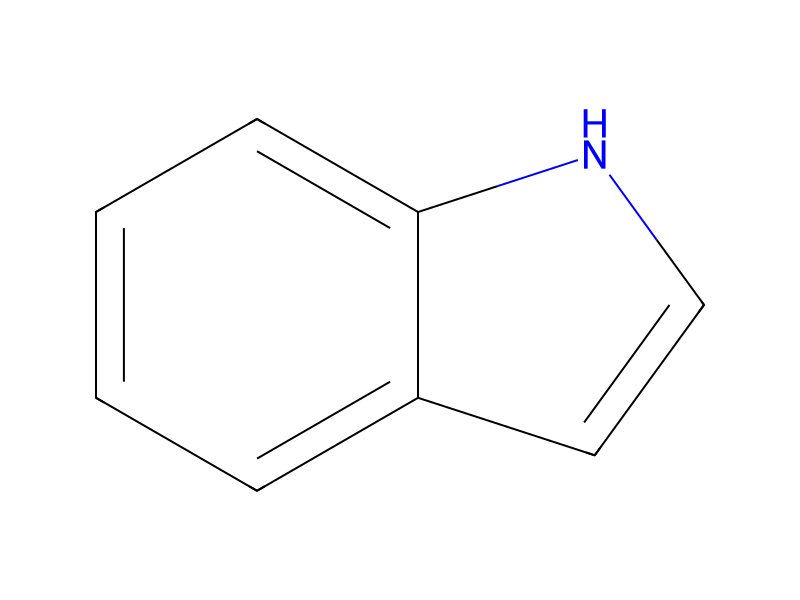
Trifluoroacetic acid → Indole
Reaction equation

COC(=O)[C@@H](N)C[C:6]1[C:14]2[C:9](=[CH:10][CH:11]=[CH:12][CH:13]=2)[N:8](CC2C=C(Cl)C=C(Cl)C=2)[CH:7]=1.FC(F)(F)C(O)=O>ClCCl>[NH:8]1[C:9]2[C:14](=[CH:13][CH:12]=[CH:11][CH:10]=2)[CH:6]=[CH:7]1Participants


Reagents, catalysts & solvents 1

Procedure
(S)-2-tert-Butoxycarbonylamino-3-[1-(3,5-dichloro-benzyl)-1H-indol-3-yl]-propionic acid methyl ester. To a stirring suspension of potassium hydride (0.46 g, 30 wt % in mineral oil, 3.45 mmol) in tetrahydrofuran (4 mL) at −50° C. was added a solution of (S)-2-tert-Butoxycarbonylamino-3-(1H-indol-3-yl)-propionic acid methyl ester (1.0 g, 3.14 mmol) in tetrahydrofuran (6 mL). The solution was stirred for 30 minutes at −50° C., then 3,5-dichlorobenzyl bromide (0.829 g, 3.45 mmol) was added. The reaction was allowed to warm to room temperature, then stirred for 16 hours. The reaction was then quenched by the addition of water and diluted with ethyl acetate. The organic phase was separated and dried over Na2SO4, filtered and concentrated in vacuo. Purification by silica gel chromatography (30% ethyl acetate/hexanes) gave 1.2 g of the desired compound. Rt=3.46, MH+=478. 40-3: (S)-2-Amino-3-[1-(3,5-dichloro-benzyl)-1H-indol-3-yl]-propionic acid methyl ester. To a stirring solution of 40-2 (1.2 g, 2.50 mmol) in dichloromethane (8 mL) at room temperature was added trifluoroacetic acid (2 mL). The reaction was stirred at room temperature for 2 hours, then quenched with saturated aqueous sodium bicarbonate solution, and diluted with dicholoromethane. The organic phase was washed with saturated aqueous sodium bicarbonate solution twice, then dried over Na2SO4, filtered, and concentrated in vacuo to give 0.919 g of the desired compound. Rt=1.73, MH+=378. 40-4: (S,S)-2-{2-[1-(3,5-Dichloro-benzyl)-1H-indol-3-yl]-1-methoxycarbonyl-ethylamino}-4-methyl-pentanoic acid methyl ester. To a solution of (R)-4-Methyl-2-trifluoromethanesulfonyloxy-pentanoic acid methyl ester (0.746 g, 2.68 mmol) in dichloromethane (8 mL) at −70° C. was added N,N-diisopropylethylamine (0.47 mL, 2.68 mmol), followed by a solution of 40-3 (0.919 g, 2.43 mmol) in dichloromethane (8 mL) dropwise. The solution was allowed to slowly warm to room temperature, and stirred for 16 hours. The solvent was evaporated, and the residue was diluted with ethyl acetate. The solution was washed with saturated aqueous sodium bicarbonate twice, followed by brine. The organic layer was then dried over Na2SO4, filtered, and concentrated in vacuo. Purification by silica gel chromatography (10–30% ethyl acetate/hexanes) gave 0.71 g of the desired compound. Rt=3.51, MH+=506. 40-5: (S,S)-2-{1-Carboxy-2-[1-(3,5-dichloro-benzyl)-1H-indol-3-yl]-ethylamino}-4-methyl-pentanoic acid. To a stirring solution of 40-4 (0.710 g, 1.40 mmol) in tetrahydrofuran (16 mL), methanol (5.5 mL), and water (5.5 mL) at 0° C. was added lithium hydroxide monohydrate (0.236 g, 5.62 mmol). The solution was allowed to warm to room temperature and stirred for 16 hours. After concentrating the organics in vacuo, the aqueous layer was acidified with 1N HCl until a white precipitate formed which was filtered and dried to give 0.438 g of the desired compound. Rt=2.44, MH+=477. 1H NMR consistent with the assigned structure. Compounds synthesized using the same general procedure: (S,S)-2-[2-(1-Benzyl-1H-indol-3-yl)-1-carboxy-ethylamino]-4-methyl-pentanoic acid. Rt=1.93, MH+=409. (R,S)-2-[2-(1-Benzyl-1H-indol-3-yl)-1-carboxy-ethylamino]-4-methyl-pentanoic acid. Rt=2.04, MH+=409.
Workup
- customquenched with saturated aqueous sodium bicarbonate solution
- additiondiluted with dicholoromethane
- washThe organic phase was washed with saturated aqueous sodium bicarbonate solution twice
- dry with materialdried over Na2SO4
- filtrationfiltered
- concentrationconcentrated in vacuo
Sources & evidence
- ORD record
- ord-511806124ad84e14bcac73360bb0626f
- Source dataset
- uspto-grants-2006_05
- Patent number
- US07045532B2
Reaction notes
Loading…