Picric Acid → 2,4,6-Trinitroaniline
Reaction equation

[C:1]1([C:15](O)=[C:11]([N+:12]([O-:14])=[O:13])[CH:10]=[C:6]([N+:7]([O-:9])=[O:8])[CH:5]=1)[N+:2]([O-:4])=[O:3].C1(C([O-])=C([N+]([O-])=O)C=C([N+]([O-])=O)C=1)[N+:18]([O-])=O.[NH4+].S1(CCCC1)(=O)=O.CN1CCCC1=O>O>[CH:5]1[C:1]([N+:2]([O-:4])=[O:3])=[C:15]([NH2:18])[C:11]([N+:12]([O-:14])=[O:13])=[CH:10][C:6]=1[N+:7]([O-:9])=[O:8]Participants
Reactant 4
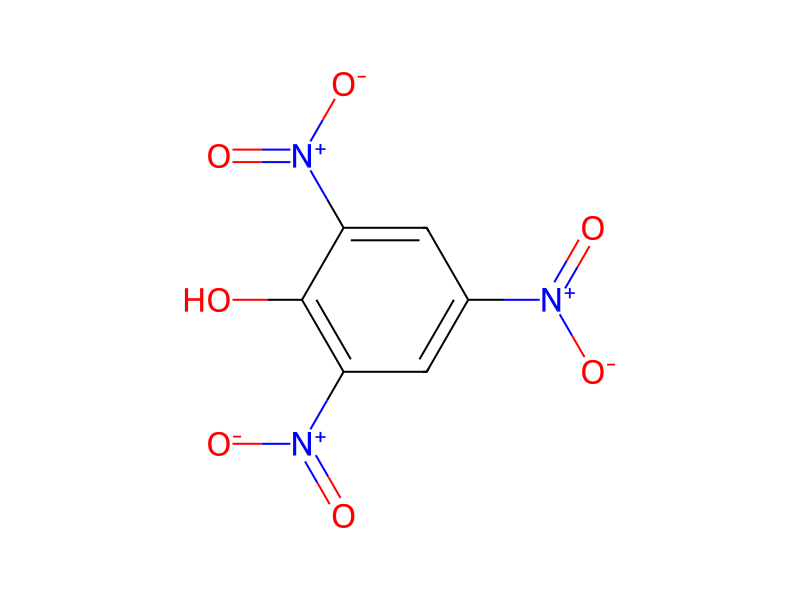



Product 1

Reagents, catalysts & solvents 1

Procedure
Replacement of urea with an ammonium salt (or “NH3 reagent”) obtained from ammonia and weak acids (e.g., acetic, carbonic acid, phosphoric acid) produces picramide free of cyanuric acid. Thus, reaction of picric acid or ammonium picrate with an ammonium salt in dipolar aprotic solvents such as sulfolane or N-methylpyrrolidinone (NMP) for several hours at 175–185° C., followed by a water wash, produces picramide that is free of cyanuric acid and ammonium salts. Ammonium hydroxide (28% NH3 in H2O) is unsatisfactory for use as an NH3 reagent as picric acid/ammonium picrate are decomposed to black solids when exposed to the ammonium hydroxide. Example 2 and Table 1 list conversions of 0.18–0.92 g of ammonium picrate in sulfolane to picramide in 8 ml glass pressure tubes.
Workup
- washwash
Sources & evidence
- ORD record
- ord-310ec31297404ffe913e7dd4f01bb353
- Source dataset
- uspto-grants-2006_06
- Patent number
- US07057072B2
Reaction notes
Loading…