Water → Morpholine-4-carboxylic Acid 4-trifluoromethyl-pyrimidin-2-yl Ester
Reaction equation
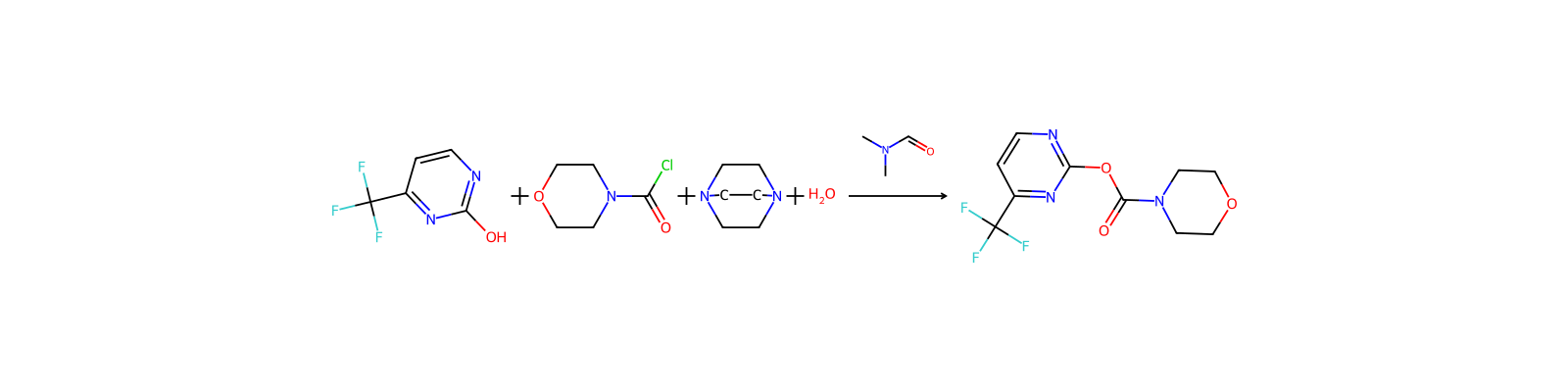
[F:1][C:2]([F:11])([F:10])[C:3]1[CH:8]=[CH:7][N:6]=[C:5]([OH:9])[N:4]=1.[N:12]1([C:18](Cl)=[O:19])[CH2:17][CH2:16][O:15][CH2:14][CH2:13]1.N12CCN(CC1)CC2.O>CN(C)C=O>[F:11][C:2]([F:1])([F:10])[C:3]1[CH:8]=[CH:7][N:6]=[C:5]([O:9][C:18]([N:12]2[CH2:17][CH2:16][O:15][CH2:14][CH2:13]2)=[O:19])[N:4]=1Participants
6




Procedure
A solution of 4-(trifluoromethyl)-2-pyrimidol (0.49 g, 3.00 mmol), 4-morpholinecarbonyl chloride (0.45 g, 3.00 mmol) and 1,4-diazabicyclo[2.2.2]octane (0.51 g, 3.00 mmol) in N,N-dimethylformamide (15 ml) was stirred at room temperature for 2 hours. Water was added and the solution was extracted twice with dichloromethane. The combined organic layers were dried over sodium sulphate, filtered and evaporated in vacuo. The residue was purified by flash column chromatography (SiO2, ethyl acetate:heptane (30:70→50:50)) yielding the title compound (0.66 g, 80% yield) as a white solid.
Workup
- extractionthe solution was extracted twice with dichloromethane
- dry with materialThe combined organic layers were dried over sodium sulphate
- filtrationfiltered
- customevaporated in vacuo
- customThe residue was purified by flash column chromatography (SiO2, ethyl acetate:heptane (30:70→50:50))
Sources & evidence
- ORD record
- ord-488fed786c9d48ad95ce24b4ccd6fb95
- Source dataset
- uspto-grants-2006_06
- Patent number
- US07067517B2
Reaction notes
Loading…