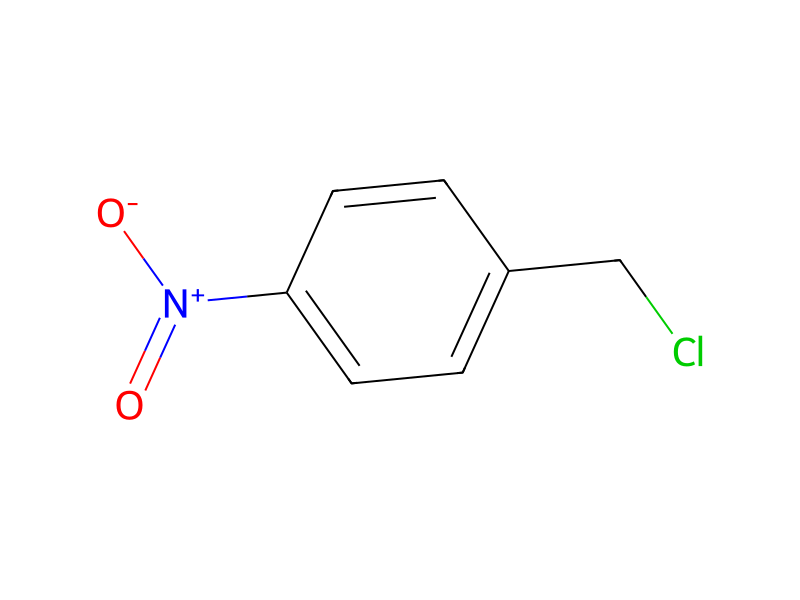
4-Nitrobenzyl chloride → HCID 15512294, compound
Reaction equation

[N+:1]([C:4]1[CH:11]=[CH:10][C:7]([CH2:8]Cl)=[CH:6][CH:5]=1)([O-:3])=[O:2].[CH3:12][NH:13][CH2:14][C:15]#[CH:16]>ClCCl.C(N(CC)CC)C>[CH3:12][N:13]([CH2:8][C:7]1[CH:10]=[CH:11][C:4]([N+:1]([O-:3])=[O:2])=[CH:5][CH:6]=1)[CH2:14][C:15]#[CH:16]Participants
Reactant 2

Product 1

Reagents, catalysts & solvents 2


Procedure
3.72 g (22.0 mmol) of p-nitrobenzyl chloride in 20 ml of dichloromethane is added, dropwise, at 0° C. to a solution of 1 g (1.45 mmol) of N-methylpropargylamine in 15 ml of dichloromethane and 3.1 ml of triethylamine. After stirring overnight, the reaction mixture is concentrated to dryness under vacuum, and the residue is diluted with dichloromethane and 40 ml of a saturated solution of NaCl. After stirring and decanting, the organic phase is separated and dried over magnesium sulphate, filtered and concentrated under vacuum. The expected product is obtained after chromatography on a silica column, eluent: (20% ethyl acetate in heptane), the pure fractions, after evaporation, produce a brown solid with a yield of 80%. Melting point 47-49° C.
Workup
- customat 0° C.
- concentrationthe reaction mixture is concentrated to dryness under vacuum
- additionthe residue is diluted with dichloromethane and 40 ml of a saturated solution of NaCl
- stirringAfter stirring
- customdecanting
- customthe organic phase is separated
- dry with materialdried over magnesium sulphate
- filtrationfiltered
- concentrationconcentrated under vacuum
Sources & evidence
- ORD record
- ord-707c2b7e2ff34ce79f4f57aeb65c5429
- Source dataset
- uspto-grants-2004_08
- Patent number
- US06770669B1
Reaction notes
Loading…