Acetone → HCID 12073548, compound
Reaction equation

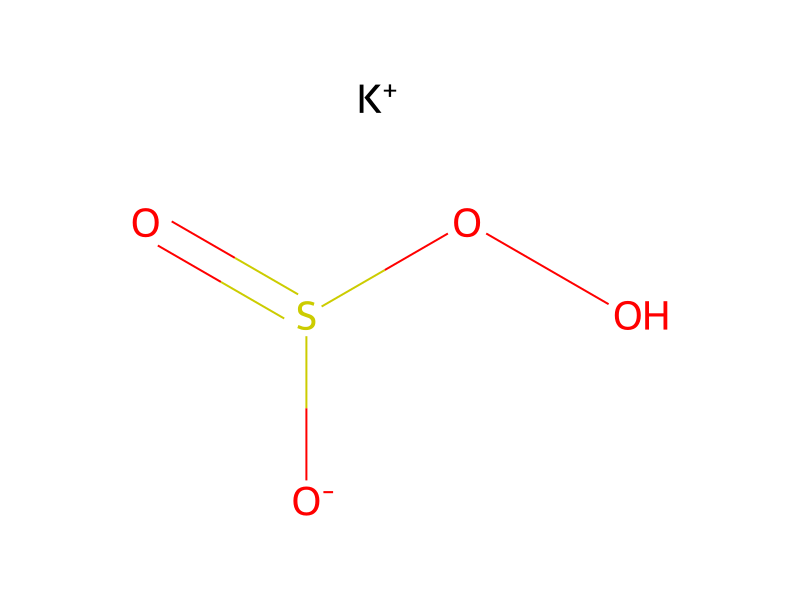
[Br:1][C:2]1[CH:7]=[CH:6][C:5]([CH3:8])=[CH:4][C:3]=1[S:9][CH2:10][C:11]#[CH:12].CC(C)=[O:15].OOS([O-])=O.[K+].O>[Br-].C([N+](CCCC)(CCCC)CCCC)CCC.C(OCC)(=O)C>[Br:1][C:2]1[CH:7]=[CH:6][C:5]([CH3:8])=[CH:4][C:3]=1[S:9]([CH2:10][C:11]#[CH:12])=[O:15]Participants






Procedure
To a solution of 1-bromo-4-methyl-2 prop-2-inylthiobenzene (62.18 g, 258 mmol), acetone (1.50 g, 25.8 mmol) and tetrabutylammonium bromide (4.16 g, 12.9 mmol) in ethyl acetate (750 ml), an aqueous solution of Oxone (166.6 g, 271 mmol) (750 ml) was added, and vigorously stirred for 21 hours. Water (250 ml) was added thereto to dissolve salts in the aqueous phase, and the aqueous phase was removed and the organic phase was washed with water (300 ml×3 times). The mixture was further washed twice with a mixture of saturated baking soda solution (100 ml) and water (200 ml), and was washed again with water (300 ml×2 times). After drying on magnesium sulfate, the solvent was evaporated to obtain 1-bromo-4-methyl-2-(prop-2-inylsulfinyl)benzene (63.37 g, 239 mmol (a value obtained by subtracting the weight of residual ethyl acetate from 1H NMR integrated ratio)). The yield was 93%.
Workup
- dissolutionto dissolve salts in the aqueous phase
- customthe aqueous phase was removed
- washthe organic phase was washed with water (300 ml×3 times)
- washThe mixture was further washed twice with a mixture of saturated baking soda solution (100 ml) and water (200 ml)
- washwas washed again with water (300 ml×2 times)
- customAfter drying on magnesium sulfate
- customthe solvent was evaporated
Sources & evidence
- ORD record
- ord-3aac422f275c4493bce4fc2c2af3c99f
- Source dataset
- uspto-grants-2004_08
- Patent number
- US06774245B2
Reaction notes
Loading…