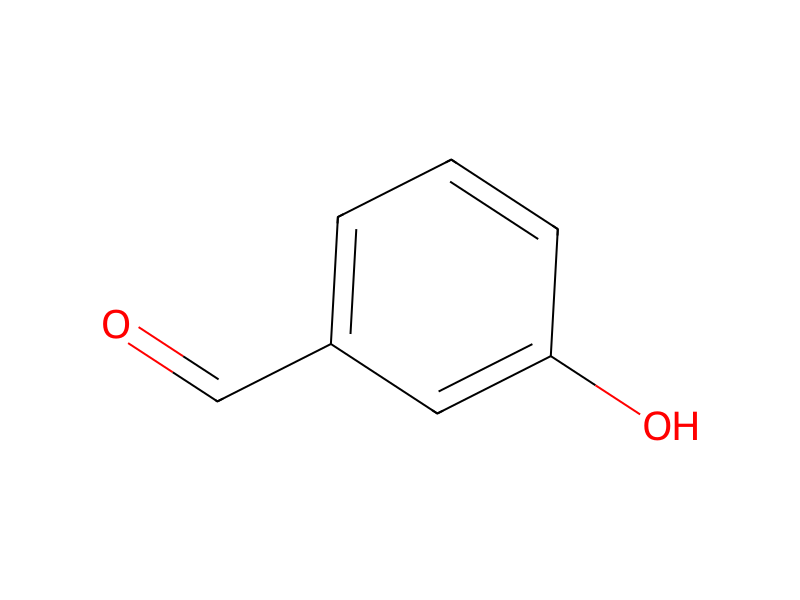
3-Hydroxybenzaldehyde → 3-(t-Butyldimethylsilyloxy)benzaldehyde
Reaction equation

[OH:1][C:2]1[CH:3]=[C:4]([CH:7]=[CH:8][CH:9]=1)[CH:5]=[O:6].N1C=CN=C1.[Si:15](Cl)([C:18]([CH3:21])([CH3:20])[CH3:19])([CH3:17])[CH3:16]>CN(C=O)C>[Si:15]([O:1][C:2]1[CH:3]=[C:4]([CH:7]=[CH:8][CH:9]=1)[CH:5]=[O:6])([C:18]([CH3:21])([CH3:20])[CH3:19])([CH3:17])[CH3:16]Participants
5
Reactant 3


Product 1

Reagents, catalysts & solvents 1

Procedure
A solution of 3.66 g of 3-hydroxybenzaldehyde, 3.1 g of imidazole, and 4.39 g of tert-butyldimethylsilyl chloride in 10 ml of DMF is stirred at room temperature for 18 h, then partitioned between ether and water. The organic phase is washed with water, dried (MgSO4), and concentrated under reduced pressure. Flash chromatography of the residue on silica gel using 5% ether-hexane provides 5.14 g of the title compound as a pale yellow liquid.
Workup
- custompartitioned between ether and water
- washThe organic phase is washed with water
- dry with materialdried (MgSO4)
- concentrationconcentrated under reduced pressure
Sources & evidence
- ORD record
- ord-78dc9d0f02eb4d84bc12273d7d0cefe2
- Source dataset
- uspto-grants-2004_01
- Patent number
- US06673793B2
Reaction notes
Loading…