Potassium Hydroxide → HCID 71183666, compound
Reaction equation

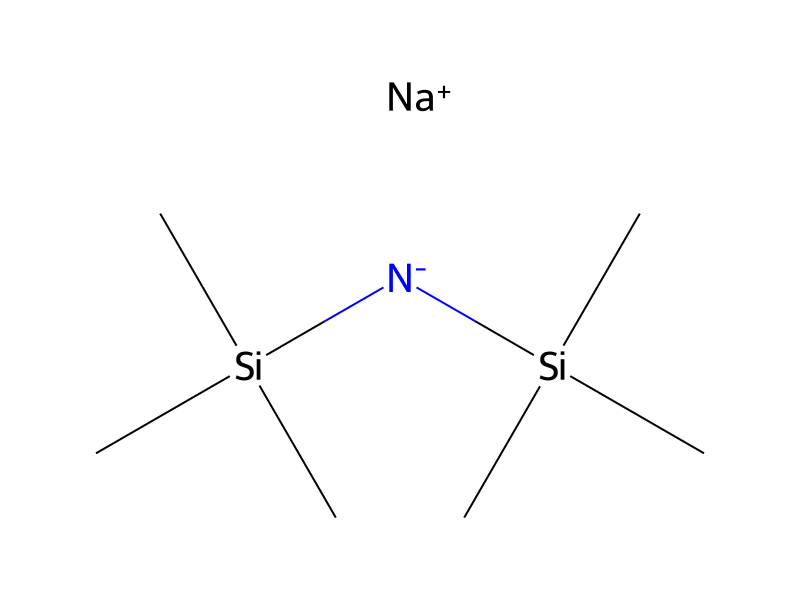
C[Si]([N-][Si](C)(C)C)(C)C.[Na+].[C:11]1([N:17]2[CH:21]=[C:20]([CH2:22][C:23]#N)[N:19]=[CH:18]2)[CH:16]=[CH:15][CH:14]=[CH:13][CH:12]=1.[CH2:25]([C@H:27]1[O:29][CH2:28]1)Cl.[OH-:30].[K+]>C1(C)C=CC=CC=1.O1CCCC1.O.C(O)C>[C:11]1([N:17]2[CH:21]=[C:20]([C@@:22]34[CH2:23][C@@H:25]3[CH2:27][O:29][C:28]4=[O:30])[N:19]=[CH:18]2)[CH:12]=[CH:13][CH:14]=[CH:15][CH:16]=1Participants
Reactant 4



Product 1

Reagents, catalysts & solvents 4




Conditions
- Temperature
- 0 °C
Procedure
A solution of sodium bis(trimethylsilyl)amide in tetrahydrofuran (1.9 M, 432 mL, 820 mmol) was slowly added to a solution of (1-phenyl-1H-imidazol-4-yl)acetonitrile (60.1 g, 328 mmol) obtained in Reference Example 21 in toluene (1500 mL) with stirring at 0° C. The mixture was stirred at 0° C. for 45 minutes. Then, a solution of (S)-epichlorohydrin (40.7 g, 427 mmol) in tetrahydrofuran (100 mL) was added dropwise thereto over 30 minutes, and the mixture was stirred at 0° C. for 1.5 hours. The reaction mixture was heated to room temperature and stirred overnight, and a 2 M aqueous potassium hydroxide solution (100 mL) and ethanol (100 mL) were then added to the reaction solution. A similar process was carried out using (1-phenyl-1H-imidazol-4-yl)acetonitrile (60.0 g, 327 mmol). These two reaction solutions were combined and concentrated. Then, ethanol (600 mL), water (600 mL), and potassium hydroxide (125 g, 1.89 mol) were added to the residue, and the mixture was heated to reflux for 3 hours. The reaction solution was concentrated. Then, water was added to the residue, and the aqueous layer was washed with toluene. To the aqueous layer, concentrated hydrochloric acid (400 mL) was added with stirring at 0° C., and the mixture was stirred for 1 hour after heating to room temperature and then stirred for 3 hours after heating to 50° C. The reaction solution was neutralized by the addition of an aqueous sodium bicarbonate solution, followed by extraction with ethyl acetate. The organic layer was dried over anhydrous magnesium sulfate. After filtration and concentration under reduced pressure, the obtained crude product was purified by silica gel column chromatography to obtain the desired compound. The compound was further recrystallized from hexane and ethyl acetate to obtain the desired compound as a yellow solid (46.5 g, 29%, >98% ee). Its optical purity was confirmed by analytical HPLC (Daicel CHIRALPAK IC 4.6×250 mm, eluting solvent: hexane/ethanol=50/50, 1.0 mL/min, 254 nm, tR=7.6 minutes ((1S,5R)-isomer), tR=8.8 minutes ((1R,5S)-isomer)).
Workup
- stirringThe mixture was stirred at 0° C. for 45 minutes
- stirringthe mixture was stirred at 0° C. for 1.5 hours
- temperatureThe reaction mixture was heated to room temperature
- stirringstirred overnight
- customThese two reaction solutions
- concentrationconcentrated
- temperaturethe mixture was heated
- temperatureto reflux for 3 hours
- concentrationThe reaction solution was concentrated
- additionThen, water was added to the residue
- washthe aqueous layer was washed with toluene
- additionTo the aqueous layer, concentrated hydrochloric acid (400 mL) was added
- stirringwith stirring at 0° C.
- stirringthe mixture was stirred for 1 hour
- temperatureafter heating to room temperature
- stirringstirred for 3 hours
- temperatureafter heating to 50° C
- additionThe reaction solution was neutralized by the addition of an aqueous sodium bicarbonate solution
- extractionfollowed by extraction with ethyl acetate
- dry with materialThe organic layer was dried over anhydrous magnesium sulfate
- filtrationAfter filtration and concentration under reduced pressure
- customthe obtained crude product
- customwas purified by silica gel column chromatography
Sources & evidence
- ORD record
- ord-324c36e3657143b98041928c6e112600
- Source dataset
- uspto-grants-2015_02
- Patent number
- US08946443B2
Reaction notes
Loading…