Pyrrolidine → Methyl 3-bromo-5-(pyrrolidine-1-carbonyl)benzoate
Reaction equation

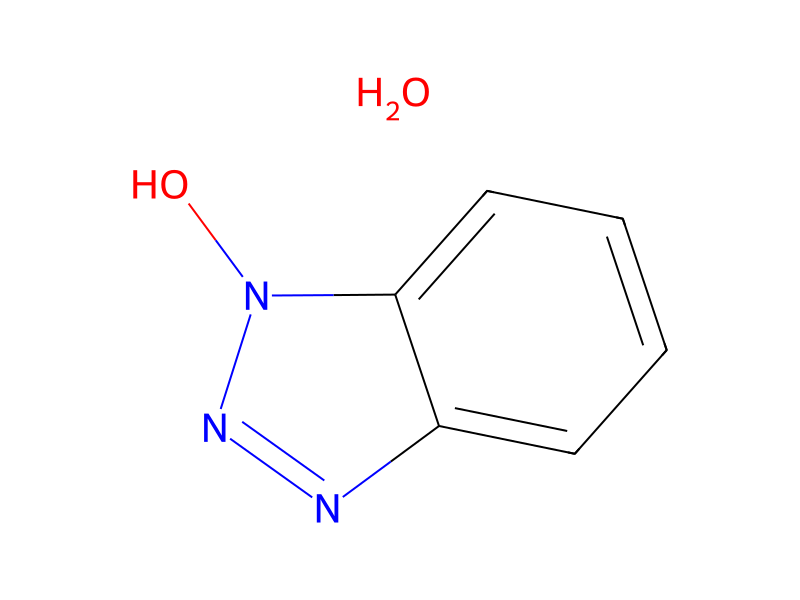
[Br:1][C:2]1[CH:3]=[C:4]([CH:8]=[C:9]([C:11]([O:13][CH3:14])=[O:12])[CH:10]=1)[C:5]([OH:7])=O.Cl.CN(C)[CH2:18][CH2:19][CH2:20][N:21]=[C:22]=NCC.O.ON1C2C=CC=CC=2N=N1.N1CCCC1.C(N(CC)C(C)C)(C)C>C(Cl)Cl>[Br:1][C:2]1[CH:10]=[C:9]([CH:8]=[C:4]([C:5]([N:21]2[CH2:22][CH2:18][CH2:19][CH2:20]2)=[O:7])[CH:3]=1)[C:11]([O:13][CH3:14])=[O:12]Participants
Reactant 5




Product 1

Reagents, catalysts & solvents 1

Procedure
To a mixture of 3-bromo-5-(methoxycarbonyl)benzoic acid (1.8 g, 5.6 mmol), N-(3-dimethylaminopropyl)-N′-ethylcarbodiimide hydrochloride (2.1 g, 11 mmol), 1-hydroxybenzotriazole hydrate (1.7 g, 11 mmol), methylene chloride (20 mL) were added pyrrolidine (0.58 g, 8.2 mmol) and N,N-diisopropylethylamine (1.9 mL, 11 mmol). The mixture was stirred at room temperature overnight, and then diluted with methylene chloride (200 mL). The organic phase was washed with aq. BaHCO3, and aq. K2HPO4, brine, dried over Na2SO4, and concentrated. The residue was purified via flash chromatography (silica gel column, 0-100 EtOAc/hexane) to afford the desired product as a clear oil. 1H NMR (400 MHz, DMSO-d6): 8.12 (t, J=1.8 Hz, 1H), 7.80-7.98 (m, 2H), 3.88 (s, 3H), 3.47 (t, J=6.7 Hz, 2H), 3.36 (t, J=6.5 Hz, 2H), 1.89-1.80 (m, 4H).
Workup
- washThe organic phase was washed with aq. BaHCO3, and aq. K2HPO4, brine
- dry with materialdried over Na2SO4
- concentrationconcentrated
- customThe residue was purified via flash chromatography (silica gel column, 0-100 EtOAc/hexane)
Sources & evidence
- ORD record
- ord-7f86ac23ef654f9dbaea975a5624318e
- Source dataset
- uspto-grants-2015_02
- Patent number
- US08946439B2
Reaction notes
Loading…