Benzyl Bromide → HCID 67353995, compound
Reaction equation

Br[C:2]1[C:3]([CH3:16])=[N:4][C:5]([N:9]2[C:13]([CH3:14])=[CH:12][CH:11]=[C:10]2[CH3:15])=[N:6][C:7]=1[CH3:8].C(P(C(C)(C)C)[C:22]1[CH:27]=[CH:26][CH:25]=[CH:24][C:23]=1[C:28]1C(C(C)C)=CC(C(C)C)=CC=1C(C)C)(C)(C)C.[OH-:47].[K+].C(Br)C1C=CC=CC=1.[H-].[Na+]>O1CCOCC1.C1C=CC(/C=C/C(/C=C/C2C=CC=CC=2)=O)=CC=1.C1C=CC(/C=C/C(/C=C/C2C=CC=CC=2)=O)=CC=1.C1C=CC(/C=C/C(/C=C/C2C=CC=CC=2)=O)=CC=1.[Pd].[Pd].O>[CH2:28]([O:47][C:2]1[C:3]([CH3:16])=[N:4][C:5]([N:9]2[C:13]([CH3:14])=[CH:12][CH:11]=[C:10]2[CH3:15])=[N:6][C:7]=1[CH3:8])[C:23]1[CH:24]=[CH:25][CH:26]=[CH:27][CH:22]=1Participants
Reactant 5




Product 1

Reagents, catalysts & solvents 3



Conditions
- Temperature
- 100 °C
Procedure
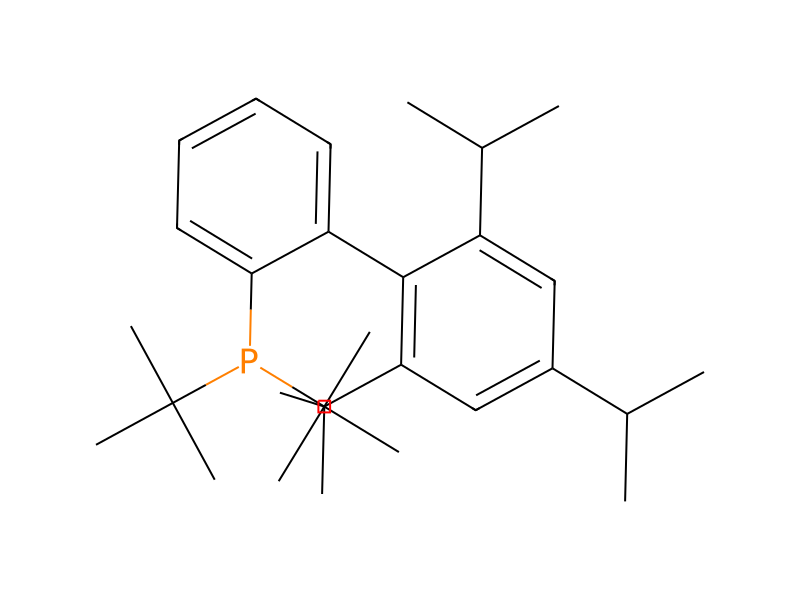
To a stirred solution containing 4.87 g (17.4 mmol) of 5-bromo-2-(2,5-dimethyl-1H-pyrrol-1-yl)-4,6-dimethylpyrimidine in 50 mL of 1:1 dioxane-degassed water was added 632 mg (0.69 mmol) of Pd2dba3 followed by 293 mg (0.69 mmol) of 2-di-tert-butylphosphino-2′,4′,6′-triisopropylbiphenyl (L1) and 2.92 g (52.1 mmol) of KOH. The reaction mixture was stirred at 100° C. for 3 h. The cooled reaction mixture was poured into 200 mL of water and extracted with 100 mL of ethyl acetate. The aqueous layer was acidified with HCl (pH 2-3) and then extracted with two 150-mL portions of ethyl acetate. The combined organic layer was washed with 150 mL of brine, dried (MgSO4) and concentrated under diminished pressure. The residue was dissolved in 50 mL of anhydrous THF and treated with 3.10 mL (26.0 mmol) of benzyl bromide followed by 1.40 g (34.8 mmol) of a 60% suspension of NaH in mineral oil. The reaction mixture was stirred at 23° C. for 48 h. The reaction mixture was quenched with satd aq sodium bicarbonate and poured into 150 mL of water and extracted with two 150-mL portions of ether. The combined organic layer was washed with 150 mL of brine, dried (MgSO4) and concentrated under diminished pressure. The residue was purified by chromatography on a silica gel column (20×6 cm). Elution with 9:1 hexanes-ethyl acetate afforded the expected product as a light yellow oil: yield 4.09 g (76%); silica gel TLC Rf 0.6 (6:1 hexanes-ethyl acetate); 1H NMR (CDCl3) δ2.29 (s, 6H), 2.47 (s, 6H), 4.92 (s, 2H), 5.86 (s, 2H) and 7.42 (m, 5H); 13C NMR (CDCl3) δ 14.1, 14.1, 19.1, 19.1, 75.3, 107.9, 107.9, 128.3, 128.6, 128.6, 129.0, 129.0, 129.2, 129.2, 136.0, 147.7, 152.3, 152.3 and 161.6; mass spectrum (APCI), m/z 307.1675 (M)+ (C19H21N3O requires 307.1685).
Workup
- customdegassed water
- customThe cooled reaction mixture
- extractionextracted with 100 mL of ethyl acetate
- extractionextracted with two 150-mL portions of ethyl acetate
- washThe combined organic layer was washed with 150 mL of brine
- dry with materialdried (MgSO4)
- concentrationconcentrated under diminished pressure
- dissolutionThe residue was dissolved in 50 mL of anhydrous THF
- stirringThe reaction mixture was stirred at 23° C. for 48 h
- customThe reaction mixture was quenched with satd aq sodium bicarbonate
- additionpoured into 150 mL of water
- extractionextracted with two 150-mL portions of ether
- washThe combined organic layer was washed with 150 mL of brine
- dry with materialdried (MgSO4)
- concentrationconcentrated under diminished pressure
- customThe residue was purified by chromatography on a silica gel column (20×6 cm)
- washElution with 9:1 hexanes-ethyl acetate
Sources & evidence
- ORD record
- ord-7f57fcdc530a4ad88e1efbd2c31c1aa8
- Source dataset
- uspto-grants-2015_02
- Patent number
- US08952025B2
Reaction notes
Loading…