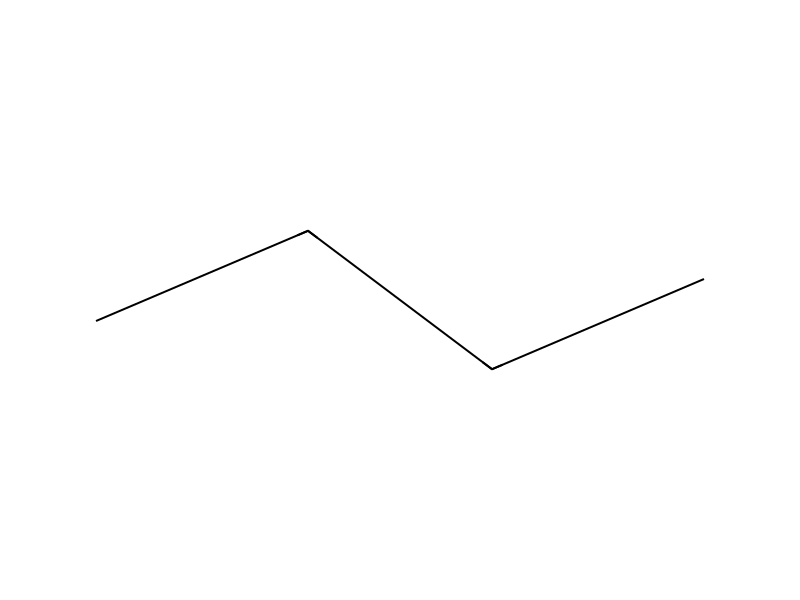
Toluene → Butane
Reaction equation

CC.C([Zn]CC)C.[CH:8]1([C:11]#C)[CH2:10][CH2:9]1.C1(C)C=CC=CC=1.[CH2:20]([Li:24])[CH2:21][CH2:22][CH3:23].NC1C=CC(Cl)=CC=1C(=O)C(F)(F)F.[H][H]>C1COCC1.C1(C)C=CC=CC=1>[CH3:11][CH2:8][CH2:9][CH3:10].[CH2:20]([Li:24])[CH2:21][CH2:22][CH3:23]Participants
Reactant 7







Product 2
Reagents, catalysts & solvents 1

Procedure
A solution of (1R,2S)-PNE (18.1%-w/w, 171.6 g, 151 mmol) in a THF/toluene mixture (9:1-w/w) was charged in a vessel and cooled to 17° C. A solution of diethylzinc in toluene (29%-w/w, 52.0 g, 122 mmol) was added at 15 to 20° C. and the mixture was aged at said temperature for 30 min. Ethane (approx. 1 equivalent in respect to diethylzinc) was formed during the diethylzinc addition and partially released from the reaction mixture. The ethane release is observed with a delay with respect to the diethylzinc addition, since ethane is first dissolved in the reaction solution and then released to the gas phase. According to 1H-NMR analysis some ethane remained dissolved in the reaction mixture. A solution of cyclopropylacetylene (compound of formula III, wherein R2 is cyclopropyl) in toluene (70%-w/w, 57.0 g, 600 mmol) was added at 15 to 20° C. and the resulting mixture was aged at 20° C. for 1 h. During the addition of cyclopropylacetylene additional ethane (approx. 1 equivalent in respect to diethylzinc) was formed and released to the gas phase. A solution of butyllithium (BuLi) in toluene (157.6 g, 2.92 mol/kg, 460 mmol) and a solution of 1-(2-amino-5-chlorophenyl)-2,2,2-trifluoroethanone (SD570, compound of formula IV, wherein R1 is trifluoromethyl, R8 is 5-chloro, R9 is hydrogen and R10 is hydrogen) (40.1%-w/w, 278.0 g, 500 mmol) in THF/toluene (1:1-w/w) were added in parallel to the reaction mixture at 20° C. within 180 min. The addition of BuLi was started 10 min in advance of the SD570 addition. Butane was formed during BuLi addition. However, most of the butane remained dissolved in the reaction mixture and only weak gas formation was observed. The course of reaction can be followed online, for example by calorimetric measurements or by “React IR” also called “in-situ FTIR”. After complete addition of SD570 the reaction mixture was stirred for 30 min at 20° C., then heated to 30° C. over a period of 60 min and aged for 6 h at 30° C. The reaction mixture was stirred at 0° C. overnight, diluted with toluene (218 g) at 20° C. and quenched by addition of aqueous citric acid (1 M, 375 g). After stirring for 15 min the phases were separated and the aqueous phase was discarded. The organic phase was successively washed with water (76 g), aqueous NaHCO3 solution (5%-w/w, 200 g), and again water (100 g). The organic phase was partially concentrated, then diluted with toluene (250 g), again partially concentrated and diluted with toluene (976 g residue). The enantiomeric purity (ep) of (S)-2-(2-amino-5-chlorophenyl)-4-cyclopropyl-1,1,1-trifluorobut-3-yn-2-ol (SD573) in the crude product was approx. 96 to 97% according to Method B. Although not belonging to the preparation process, described is also a process to transfer the product in a more stable form as a methanesulfonic acid salt. The residue was diluted with isopropyl alcohol (126.6 g). Then methanesulfonic acid (43.3 g) was added over a period of 30 min at 30° C. Seeding crystals (between 1 and 10 mg) were added and the mixture aged for 30 min at 30° C. A second portion of methanesulfonic acid (26.5 g) was added over a period of 60 min at 30° C. The resulting solution was aged for 30 min at 30° C. and later cooled to 5° C. over a period of 60 min. After further aging at 5° C. for 30 min, the product was filtered and washed with cold toluene/isopropyl alcohol (10:1-w/w, 262 g) at 5° C. The wet methanesulfonic acid salt of SD573 ((S)-2-(2-amino-5-chlorophenyl)-4-cyclopropyl-1,1,1-trifluorobut-3-yn-2-ol mesylate (2:3 mol/mol, SD573-MSA, compound of formula II, wherein R1 is trifluoromethyl, R2 is cyclopropyl, R8 is 5-chloro, R9 is hydrogen and R10 is hydrogen) was dried in vacuo at 40° C. to obtain 188.3 g (432 mmol, 86.5% yield). SD573-MSA was obtained with a purity of 99.9% and 99.7% ep, according to Method A.
Workup
- dissolutionis first dissolved in the reaction solution
- dissolutionremained dissolved in the reaction mixture
- customwas formed
- additionwas started 10 min in advance of the SD570 addition
Sources & evidence
- ORD record
- ord-b889e60e34e34ba984d1bede7d85162b
- Source dataset
- uspto-grants-2015_02
- Patent number
- US08957204B2
Reaction notes
Loading…