Ethylene Glycol → 4-(1,3-dioxolan-2-yl)pyridine
Reaction equation

[N:1]1[CH:6]=[CH:5][C:4]([CH:7]=[O:8])=[CH:3][CH:2]=1.[CH2:9](O)[CH2:10][OH:11].C1(C)C=CC(S(O)(=O)=O)=CC=1.[OH-].[Na+]>C1C=CC=CC=1>[O:8]1[CH2:9][CH2:10][O:11][CH:7]1[C:4]1[CH:5]=[CH:6][N:1]=[CH:2][CH:3]=1Participants
Reactant 4


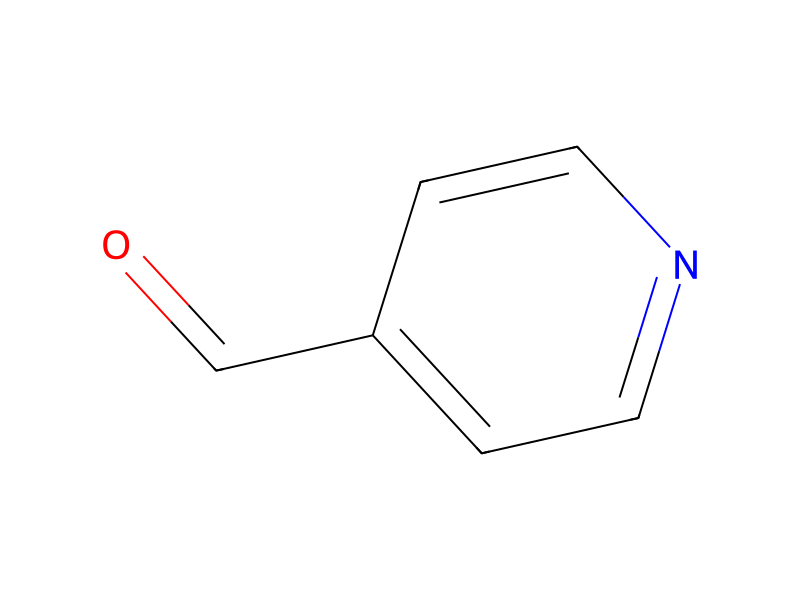

Product 1

Reagents, catalysts & solvents 1

Procedure
A stirred solution of pyridine-4-carboxaldehyde (8.7 ml, 90 mmol), ethylene glycol (10 ml, 180 mmol) and p-toluene sulfonic acid (18.8 g, 99 mmol) in benzene (70 ml) was refluxed overnight. A Dean-Stark apparatus was used to remove water azeotropically from the reaction. After ˜15 h the mixture was cooled, then made basic with aq. NaOH (20% w/v, ˜30 ml). The benzene layer was isolated and the aqueous layer was washed with dichloromethane until no more product came out (˜5×60 ml). The combined organic phases were dried (Na2SO4) and solvent removed in vacuo to give the pure 4-(1,3 dioxolan-2-yl) pyridine [Registry No. 61379-59-7] as a pale yellow liquid that solidified under vacuum (12.57 g, 92%). 1H NMR (300 MHz, CDCl3): δ 4.06 (4H, m, O—(CH2)2—O), 5.82 (1H, s, O—CH—O), 7.39 (2H, d, J=6-Hz, H-3, H-5), 8.63 (2H, d, J=6 Hz, H-2, H-6) ppm.
Workup
- customto remove water
- customazeotropically from the reaction
- temperatureAfter ˜15 h the mixture was cooled
- washthe aqueous layer was washed with dichloromethane until no more product
- dry with materialThe combined organic phases were dried (Na2SO4) and solvent
- customremoved in vacuo
Sources & evidence
- ORD record
- ord-6f85a846b70b480299678bebbdc65d9f
- Source dataset
- uspto-grants-2015_02
- Patent number
- US08962003B2
Reaction notes
Loading…