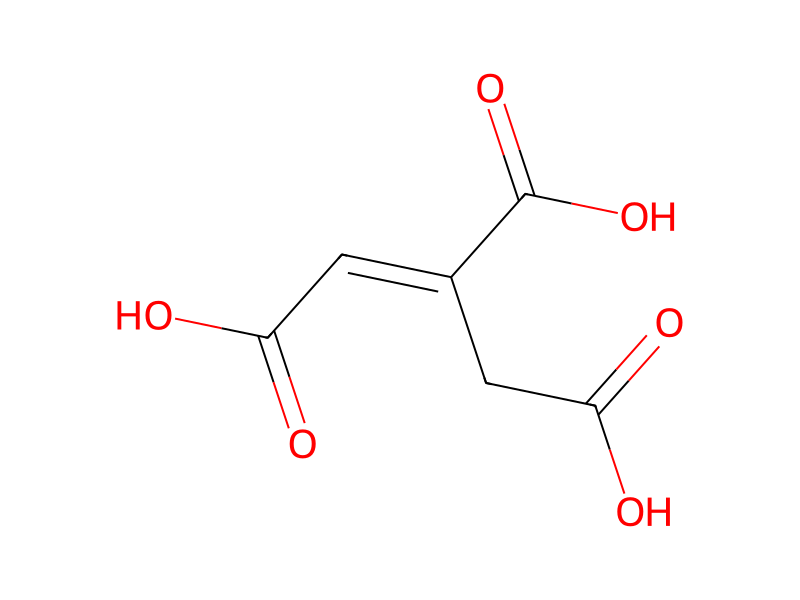
Carbon Dioxide → trans-Aconitic acid
Reaction equation

[C:1](C([O-])=O)([C:10]([O-:12])=[O:11])=[C:2]([C:7]([O-:9])=[O:8])[CH2:3][C:4]([O-:6])=[O:5].[Na+].[Na+].[Na+].[Na+].Cl.C(=O)=O>O>[CH2:3]([C:4]([OH:6])=[O:5])/[C:2](/[C:7]([OH:9])=[O:8])=[CH:1]\[C:10]([OH:12])=[O:11]Participants
5
Reactant 3



Product 1
Reagents, catalysts & solvents 1

Procedure
Nine grams of the product as prepared in Example XXIII, i.e. tetrasodium propene-1,1,2,3-tetracarboxylate, is dissolved in 100 mls water and acidified with dilute HCl (10%). Liberation of CO2 is instantaneous. The residue, after evaporation of water, is extracted with acetone. The acetone is evaporated to leave a residue consisting of a 1:1 by weight mixture of cis:trans aconitric acid. The structure of the product is confirmed by NMR analysis (D2O): ##STR77##
Workup
- customThe residue, after evaporation of water
- extractionis extracted with acetone
- customThe acetone is evaporated
- customto leave a residue
- additionconsisting of a 1:1 by weight mixture of cis
Sources & evidence
- ORD record
- ord-0670b6a2080a46bba590dec9101c2ea6
- Source dataset
- uspto-grants-1980_08
- Patent number
- US04218381
Reaction notes
Loading…