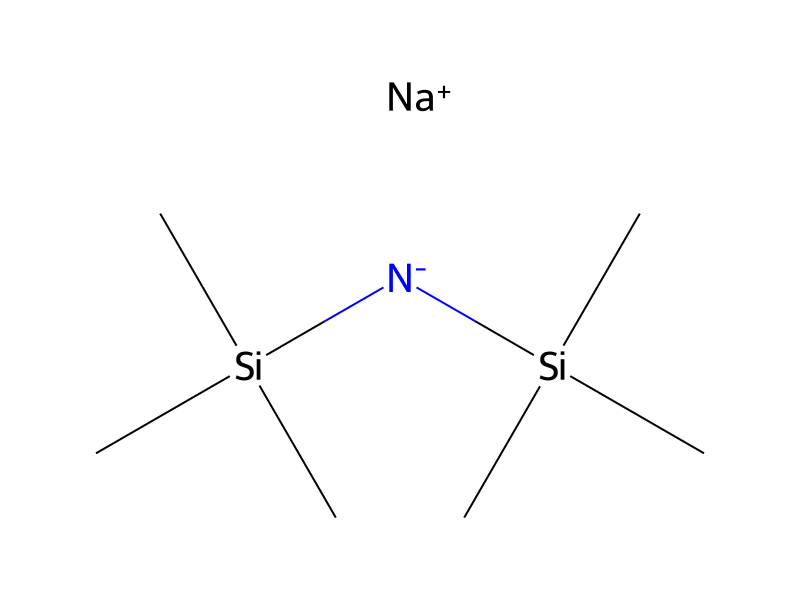
Sodium bis(trimethylsilyl)amide → 7-chloro-4-hydroxy-6-nitro-3-(thiophen-2-yl)quinolin-2(1H)-one
Reaction equation

CO[C:3](=[O:23])[C:4]1[CH:9]=[C:8]([N+:10]([O-:12])=[O:11])[C:7]([Cl:13])=[CH:6][C:5]=1[NH:14][C:15](=[O:22])[CH2:16][C:17]1[S:18][CH:19]=[CH:20][CH:21]=1.C[Si]([N-][Si](C)(C)C)(C)C.[Na+]>O1CCCC1>[Cl:13][C:7]1[CH:6]=[C:5]2[C:4]([C:3]([OH:23])=[C:16]([C:17]3[S:18][CH:19]=[CH:20][CH:21]=3)[C:15](=[O:22])[NH:14]2)=[CH:9][C:8]=1[N+:10]([O-:12])=[O:11]Participants
4



Procedure
To a solution of 4-chloro-5-nitro-2-(2-thiophen-2-yl-acetylamino)-benzoic acid methyl ester (130 mg in 4.0 mL dry tetrahydrofuran) at 0° C. was added dropwise a solution of sodium bis(trimethylsilyl)amide (0.92 mL of a 1.0M solution in tetrahydrofuran) and the mixture warmed to room temperature. After 3 hours, the reaction was quenched by the addition of 6N hydrochloric acid. The slurry was stirred for 10 minutes then filtered and washed with ice cold acetonitrile. The residue was dried in vacuo to give the title compound (79 mg).
Workup
- customthe reaction was quenched by the addition of 6N hydrochloric acid
- filtrationthen filtered
- washwashed with ice cold acetonitrile
- customThe residue was dried in vacuo
Sources & evidence
- ORD record
- ord-77b4e7fb5cd449d6b74d78aa7113f971
- Source dataset
- uspto-grants-2000_11
- Patent number
- US06150522
Reaction notes
Loading…