Hydrogen Peroxide → 1-Phenyl-1,2-ethanediol
Reaction equation

C[Si](C)([CH2:9][CH:10]([OH:17])[C:11]1[CH:16]=[CH:15][CH:14]=[CH:13][CH:12]=1)C1C=CC=CN=1.[F-].[K+].C(=O)([O-])[OH:22].[K+].OO>CO.O>[C:11]1([CH:10]([OH:17])[CH2:9][OH:22])[CH:16]=[CH:15][CH:14]=[CH:13][CH:12]=1Participants




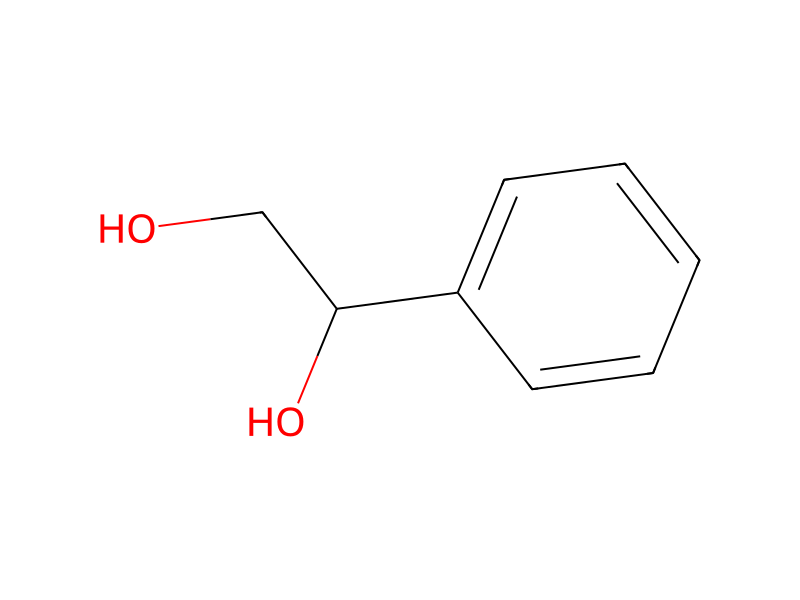


Conditions
- Temperature
- 50 °C
Procedure
To 129 mg (0.5 mmol) of the (2-hydroxy-2-phenylethyl)(2-pyridyl)silane obtained in Example 6, a solution of 58 mg (1.0 mmol) of potassium fluoride and 100 mg(1.0 mmol) of potassium hydrogencarbonate in methanol(1 ml)tetrahydrofuran(1 ml) was added, followed by 1.71 g (15 mmol) of 30% aqueous hydrogen peroxide. The mixture was continued to be stirred at an inner temperature of 50° C. for 6 hours, and then cooled to room temperature. After addition of 10 ml of water, the mixture was extracted with four portions of 10 ml of diethyl ether. The separated organic layers were combined together and washed with 10 ml of a 15% aqueous sodium thiosulfate solution. After drying over magnesium sulfate, the residue after the evaporation of the solvent was purified with silica gel chromatograph to give 66 mg of phenyl-1,2-ethanediol. Yield: 96%
Workup
- temperaturecooled to room temperature
- extractionthe mixture was extracted with four portions of 10 ml of diethyl ether
- washwashed with 10 ml of a 15% aqueous sodium thiosulfate solution
- dry with materialAfter drying over magnesium sulfate
- customthe residue after the evaporation of the solvent
- customwas purified with silica gel chromatograph
Sources & evidence
- ORD record
- ord-d56aedfff33d4ccd8072774be316ad90
- Source dataset
- uspto-grants-2003_03
- Patent number
- US06531602B2
Reaction notes
Loading…