4-Methylmorpholine → 4-Nitrophenyl 1,3-thiazol-5-ylmethyl carbonate
Reaction equation

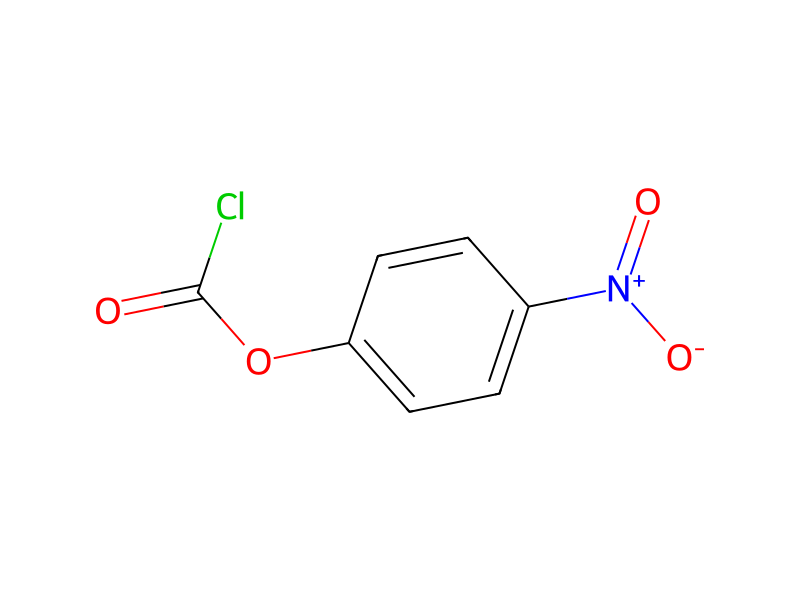
[OH:1][CH2:2][C:3]1[S:7][CH:6]=[N:5][CH:4]=1.CN1CCOCC1.Cl[C:16]([O:18][C:19]1[CH:24]=[CH:23][C:22]([N+:25]([O-:27])=[O:26])=[CH:21][CH:20]=1)=[O:17]>C(Cl)Cl.C(Cl)(Cl)Cl>[CH:23]1[C:22]([N+:25]([O-:27])=[O:26])=[CH:21][CH:20]=[C:19]([O:18][C:16]([O:1][CH2:2][C:3]2[S:7][CH:6]=[N:5][CH:4]=2)=[O:17])[CH:24]=1Participants
6





Procedure
A solution of 3.11 g (27 mmol) of 5-(hydroxymethyl)thiazole and excess N-methyl morpholine in 100 ml of methylene chloride was cooled to 0° C. and treated with 8.2 g (41 mmol) of 4-nitrophenyl chloroformate. After being stirred for 1 h, the reaction mixture was diluted with CHCl3, washed successively with 1 N HCl, saturated aqueous NaHCO3, and saturated brine, dried over NaSO4, and concentrated in vacuo. The residue was purified by silica gel chromatography (SiO2, 1-2% MeOH/CHCl3, Rf=0.5 in 4% MeOH/CHCl3) to yield 5.9 g (78%) of the desired compound as a yellow solid. NMR (CDCl3) δ 5.53 (s, 2 H), 7.39 (dt, J=9, 3 Hz, 2 H), 8.01 (s, 1 H), 8.29 (dt, J=9, 3 Hz, 2 H), 8.90 (s, 1 H). Mass spectrum: (M+H)+=281.
Workup
- washwashed successively with 1 N HCl, saturated aqueous NaHCO3, and saturated brine
- dry with materialdried over NaSO4
- concentrationconcentrated in vacuo
- customThe residue was purified by silica gel chromatography (SiO2, 1-2% MeOH/CHCl3, Rf=0.5 in 4% MeOH/CHCl3)
Sources & evidence
- ORD record
- ord-276a29540ea94cc8b7fe1d71c2a5b26b
- Source dataset
- uspto-grants-2003_03
- Patent number
- US06531610B1
Reaction notes
Loading…