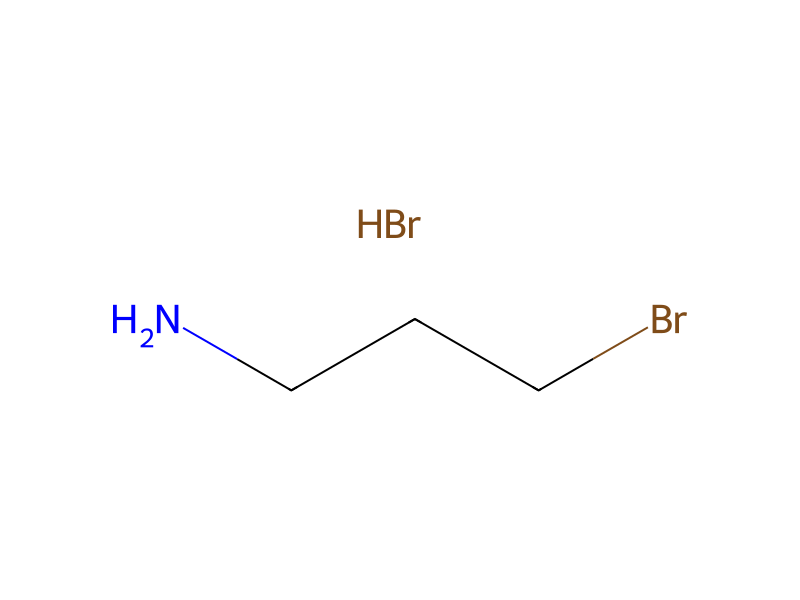
3-Bromopropylamine hydrobromide → HCID 178523266, compound
Reaction equation

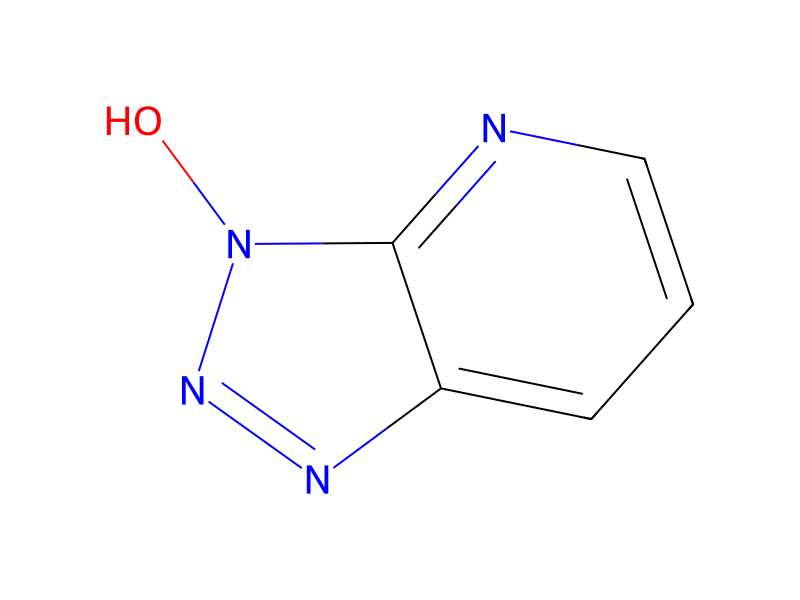
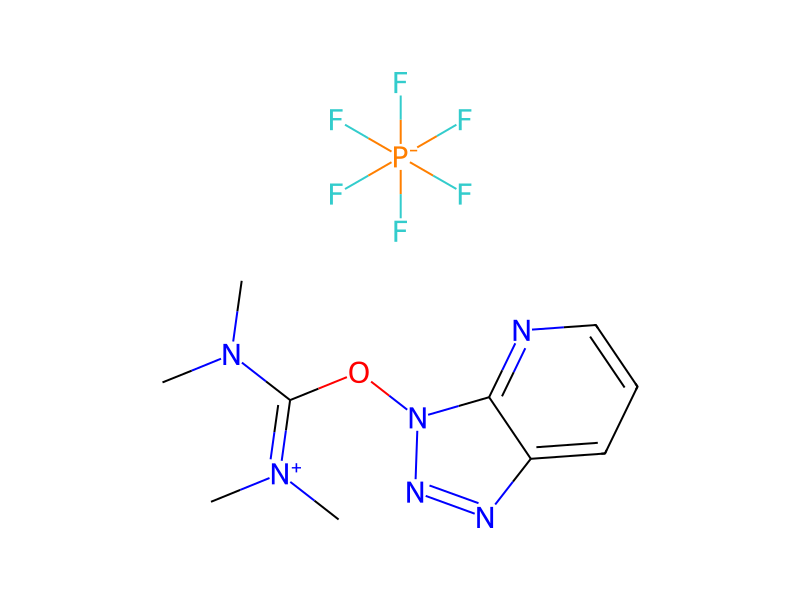
[F:1][C:2]([F:12])([F:11])[C:3]1[CH:7]=[C:6]([C:8]([OH:10])=O)[NH:5][N:4]=1.Br.[Br:14][CH2:15][CH2:16][CH2:17][NH2:18].C(N(CC)C(C)C)(C)C.F[P-](F)(F)(F)(F)F.N1(OC(N(C)C)=[N+](C)C)C2N=CC=CC=2N=N1.ON1C2N=CC=CC=2N=N1>ClCCl>[Br:14][CH2:15][CH2:16][CH2:17][NH:18][C:8]([C:6]1[NH:5][N:4]=[C:3]([C:2]([F:1])([F:12])[F:11])[CH:7]=1)=[O:10]Participants
Reactant 5


Product 1

Reagents, catalysts & solvents 1

Procedure
To a solution of 500 mg (2.78 mmol) of 3-(trifluoromethyl)-1H-pyrazole-5-carboxylic acid, 682 mg (3.05 mmol) of 3-bromopropylamine hydrobromide, and 1.4 mL (1.04 g, 8.04 mmol) of N,N-diisopropylethylamine in 20 mL of dichloromethane were added 1.2 g (3.06 mmol) of O-(7-azabenzotriazol-1-yl)-N,N,N′,N′-tetramethyluronium hexafluorophosphate (HATU) and 459 mg (3.38 mmol) of 1-hydroxy-7-azabenzotriazole (HOAT). After being stirred at room temperature for 45 min, the reaction mixture was partitioned between dichloromethane and saturated sodium carbonate aqueous solution. The organic phase was washed with 5% aqueous citric acid solution, then dried over sodium sulfate, and concentrated. The residue was leached with dichloromethane containing a little methanol. Concentration of the organic extract yielded the title compound. LC-MS 300, 302 (M+1).
Workup
- customthe reaction mixture was partitioned between dichloromethane and saturated sodium carbonate aqueous solution
- washThe organic phase was washed with 5% aqueous citric acid solution
- dry with materialdried over sodium sulfate
- concentrationconcentrated
- extractionConcentration of the organic extract
Sources & evidence
- ORD record
- ord-ae66c29692214365b6bf92cab15b4271
- Source dataset
- uspto-grants-2009_12
- Patent number
- US07625888B2
Reaction notes
Loading…