Cyclopropanecarbonyl chloride → N-(4-bromobenzyl)cyclopropanecarboxamide
Reaction equation

Cl.[Br:2][C:3]1[CH:10]=[CH:9][C:6]([CH2:7][NH2:8])=[CH:5][CH:4]=1.CCN(C(C)C)C(C)C.[CH:20]1([C:23](Cl)=[O:24])[CH2:22][CH2:21]1>ClCCl>[Br:2][C:3]1[CH:10]=[CH:9][C:6]([CH2:7][NH:8][C:23]([CH:20]2[CH2:22][CH2:21]2)=[O:24])=[CH:5][CH:4]=1Participants
5
Reactant 3
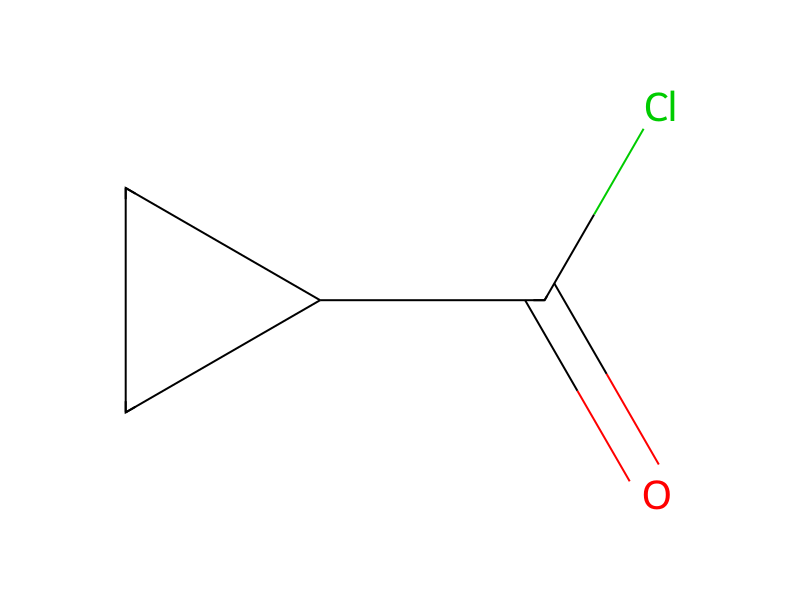


Product 1

Reagents, catalysts & solvents 1

Conditions
- Temperature
- 0 °C
Procedure
4-Bromo-benzylamine hydrochloride (367.8 mg, 1.7 mmol) was dissolved in dichloromethane (15 mL), and the solution was cooled to 0° C. DIEA (380 μL, 2.2 mmol) was then added, and the reaction was stirred at 0° C. for 5 minutes. Then cyclopropanecarbonyl chloride (180 μL, 2.3 mmol) was added, and the reaction was stirred at 0° C. for 20 minutes. The reaction was quenched with distilled water, and the solvents were removed. The resulting mixture was redissolved in DMF (10 mL) and purified by reverse phase HPLC to give the desired product.
Workup
- stirringthe reaction was stirred at 0° C. for 20 minutes
- customThe reaction was quenched with distilled water
- customthe solvents were removed
- dissolutionThe resulting mixture was redissolved in DMF (10 mL)
- custompurified by reverse phase HPLC
Sources & evidence
- ORD record
- ord-0d6614e9d7a64813a0212924a8ef14dc
- Source dataset
- uspto-grants-2009_12
- Patent number
- US07629340B2
Reaction notes
Loading…