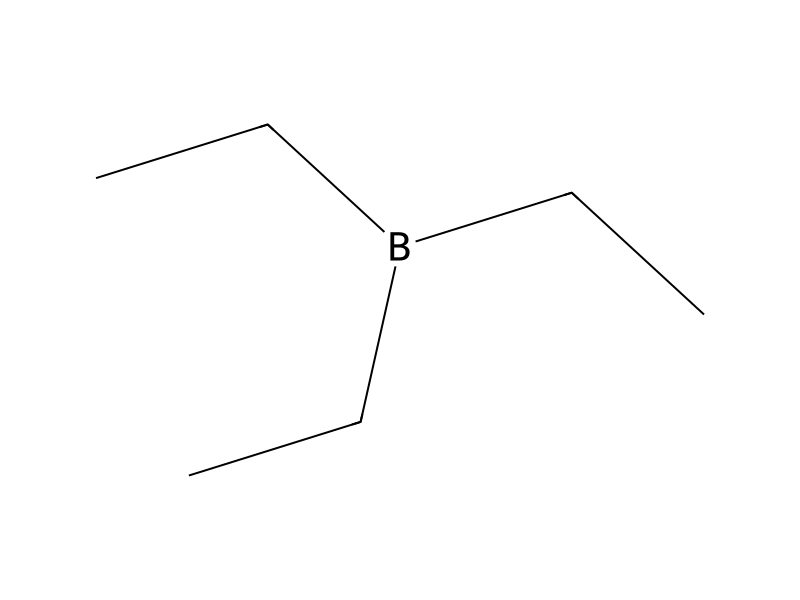
Triethylborane → 5-Ethyl-2-fluoropyridine
Reaction equation

Br[C:2]1[CH:3]=[CH:4][C:5]([F:8])=[N:6][CH:7]=1.[CH2:9](B(CC)CC)[CH3:10].C([O-])([O-])=O.[K+].[K+]>CN(C)C=O.O.C1C=CC([P]([Pd]([P](C2C=CC=CC=2)(C2C=CC=CC=2)C2C=CC=CC=2)([P](C2C=CC=CC=2)(C2C=CC=CC=2)C2C=CC=CC=2)[P](C2C=CC=CC=2)(C2C=CC=CC=2)C2C=CC=CC=2)(C2C=CC=CC=2)C2C=CC=CC=2)=CC=1>[CH2:9]([C:2]1[CH:3]=[CH:4][C:5]([F:8])=[N:6][CH:7]=1)[CH3:10]Participants
7






Procedure
A mixture of 5-bromo-2-fluoropyridine (2-a, 5.03 g, 28.6 mmol, Lancaster Synthesis, Inc., Wyndham, N.H.), triethylborane (1M in tetrahydroftiran, 42.8 mL, 42.8 mmol), K2CO3 (15.8 g, 114.2 mmol) and Pd(PPh3)4 (1.65 g, 1.43 mmol) in N,N-dimethylformamide was heated at 85 C for 4 h. The reaction mixture was diluted with water and extracted with hexanes. The organic layer was then washed with water (×2), separated, dried (MgSO4), and concentrated in vacuo. Chromatography (50%, CH2Cl2 in hexanes) afforded the desired product (2-b); 1H NMR (500 MHz, CDCl3) δ 8.04 (d, 1H, J =1.0 Hz), 7.60 (dt, 1H, J=8.0, 2.5 Hz), 6.85 (dd, 1H, J=8.3, 2.8 Hz), 2.65 (q, 2H, J=7.8 Hz), 1.21 (t, 3H, J=7.7Hz)
Workup
- temperaturewas heated at 85 C for 4 h
- extractionextracted with hexanes
- washThe organic layer was then washed with water (×2)
- customseparated
- dry with materialdried (MgSO4)
- concentrationconcentrated in vacuo
Sources & evidence
- ORD record
- ord-17000aeea3ff4ffdaa2c5d8bdf62657a
- Source dataset
- uspto-grants-2009_12
- Patent number
- US07629367B2
Reaction notes
Loading…