Hydrochloric Acid → 5-Cyclohexylsulfanyl-isoindole-1,3-dione
Reaction equation

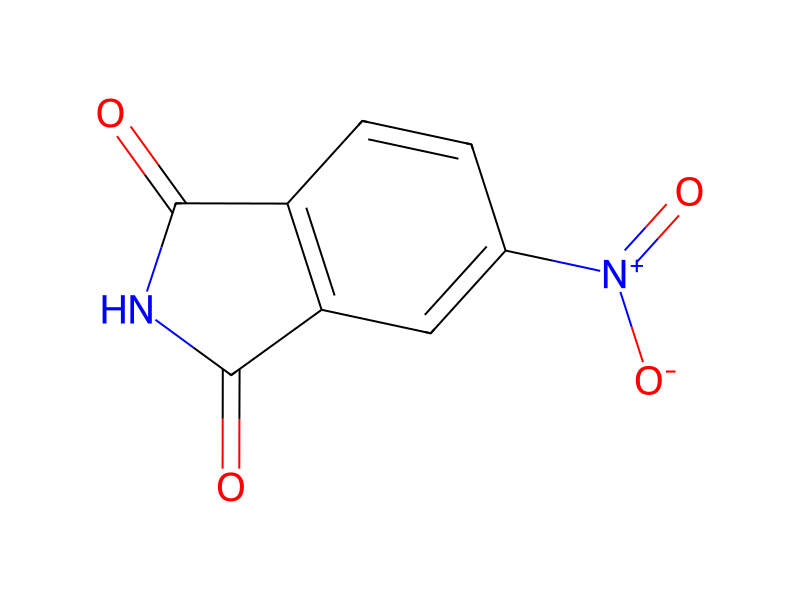
[N+]([C:4]1[CH:5]=[C:6]2[C:10](=[CH:11][CH:12]=1)[C:9](=[O:13])[NH:8][C:7]2=[O:14])([O-])=O.[CH:15]1([SH:21])[CH2:20][CH2:19][CH2:18][CH2:17][CH2:16]1.C(=O)([O-])[O-].[K+].[K+].Cl>CC(C)=O.O>[CH:15]1([S:21][C:4]2[CH:5]=[C:6]3[C:10](=[CH:11][CH:12]=2)[C:9](=[O:13])[NH:8][C:7]3=[O:14])[CH2:20][CH2:19][CH2:18][CH2:17][CH2:16]1Participants






Procedure
A mixture of 5-nitro-isoindole-1,3-dione (10.0 g), cyclohexanethiol (9.1 g) and potassium carbonate (18.7 g) in acetone (260 ml) was heated to reflux overnight. After cooling, the mixture was diluted with water (250 ml) and then acidified by 6 N HCl to pH=4. Precipitate was collected and dried in vacuo to give the intermediate 5-cyclohexylsulfanyl-isoindole-1,3-dione (15.6 g). This intermediate was dissolved in acetone (170 ml) and to the mixture was added bromo ethylacetate (10.6 g) and potassium carbonate (23.8 g). The mixture was refluxed overnight. After cooling, reaction mixture was filtered and rinsed with ethyl acetate. Filtrate was concentrated and purified by silica gel chromatography (10%-50% ethyl acetate in methylene chloride) to give the title compound (13.1 g). 1H NMR (200 MHz, CDCl3) δ 7.73 (m, 2H), 7.56 (dd, J=7.8, 1.6Hz, 1H), 4.40 (s, 2H), 4.21 (q, J=7.0Hz, 2H), 3.37 (m, 1H), 2.07-1.28 (m, 13H).
Workup
- temperaturewas heated
- temperatureto reflux overnight
- temperatureAfter cooling
- customPrecipitate was collected
- customdried in vacuo
Sources & evidence
- ORD record
- ord-b4a867fe58c444f1b636dc1578dcc3f0
- Source dataset
- uspto-grants-2009_12
- Patent number
- US07629357B2
Reaction notes
Loading…