Tributylphosphine → HCID 19078836, compound
Reaction equation

[CH2:1]([P:5]([CH2:10][CH2:11][CH2:12][CH3:13])[CH2:6][CH2:7][CH2:8][CH3:9])[CH2:2][CH2:3][CH3:4].[CH2:14]([O:18][P:19]([O:26][CH2:27][CH2:28][CH2:29][CH3:30])([O:21][CH2:22][CH2:23][CH2:24][CH3:25])=[O:20])[CH2:15][CH2:16][CH3:17]>>[CH2:22]([O:21][P:19]([O-:26])([O:18][CH2:14][CH2:15][CH2:16][CH3:17])=[O:20])[CH2:23][CH2:24][CH3:25].[CH2:10]([P+:5]([CH2:27][CH2:28][CH2:29][CH3:30])([CH2:1][CH2:2][CH2:3][CH3:4])[CH2:6][CH2:7][CH2:8][CH3:9])[CH2:11][CH2:12][CH3:13]Participants
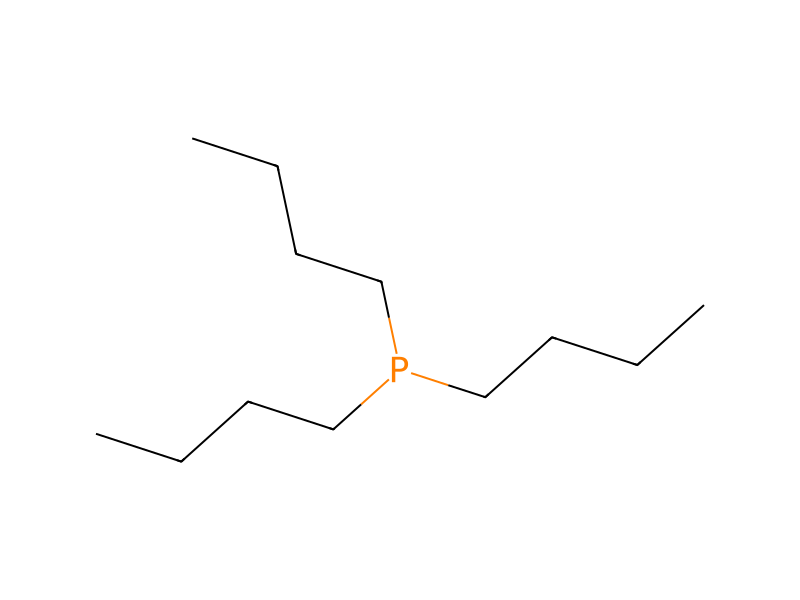


Conditions
- Temperature
- 200 °C
Procedure
Tri-n-butylphosphine (215 g, 94%, 1.0 mole) was added dropwise over a period of 4 hours to a flask containing 272 g (98%, 1.0 mole) of tributylphosphate at 170° C. When the addition was complete, the reaction mixture was heated to 200° C. and stirred at this temperature for 24 hours. The viscous liquid was dried in a rotary evaporator at 160° C./5 mm Hg for 5 hours. The product (363 g, yield 77.5%) was pure according to NMR. At room temperature the product was a white, wax-like solid (m.p. from DSC measurement: 28.0° C.). 1H-NMR (CDCl3, 300.13 MHz, δ): 3.84 (q, 4H, 2×CH3CH2CH2—CH2—O—), 2.38 (m, 8H, 4×CH3CH2CH2—CH2P+), 1.53 (m, 16H, 4×CH3—CH2CH2—CH2P+), 1.40 (m, 8H, 2×CH3—CH2CH2—CH2O—), 0.97 (m, 12H, 4×CH3—CH2CH2CH2P+), 0.90 (m, 6H, 2×CH3—CH2CH2CH2O—). 31P-NMR (CDCl3, 81.015 MHz, δ): 33.72 (P+), 0.94 [m, (RO)2—P(═O)—O−].
Workup
- additionWhen the addition
- customThe viscous liquid was dried in a rotary evaporator at 160° C./5 mm Hg for 5 hours
Sources & evidence
- ORD record
- ord-1f0c3da5c212417faff3ec72925a1a16
- Source dataset
- uspto-grants-2009_12
- Patent number
- US07638636B2
Reaction notes
Loading…