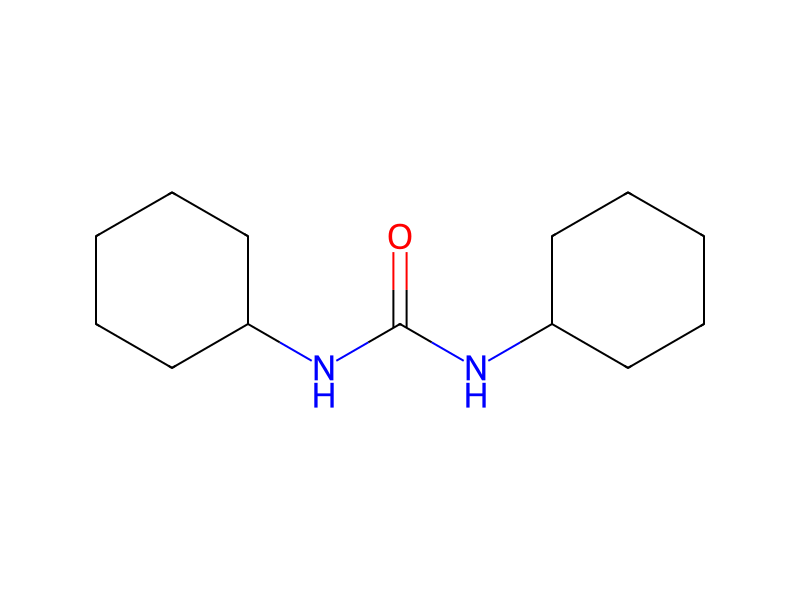
Dopamine → N,N'-Dicyclohexylurea
Reaction equation

[CH:1]1([N:7]=[C:8]=[N:9][CH:10]2[CH2:15][CH2:14][CH2:13][CH2:12][CH2:11]2)[CH2:6][CH2:5][CH2:4][CH2:3][CH2:2]1.NCCC1C=CC(O)=C([OH:22])C=1>CN(C)C1C=CN=CC=1.O1CCCC1.CCCCCC.C1C=CC=CC=1>[CH:10]1([NH:9][C:8](=[O:22])[NH:7][CH:1]2[CH2:2][CH2:3][CH2:4][CH2:5][CH2:6]2)[CH2:15][CH2:14][CH2:13][CH2:12][CH2:11]1Participants
Reactant 2


Product 1
Reagents, catalysts & solvents 4




Procedure
DHA is first converted to DHA anhydride in the presence of dicyclohexyl carbodiimide. This is then reacted with dopamine in the presence of 4-dimethylaminopyridine as the acid acceptor in tetrahydrofuran. In a typical experiment 300 mg of DHA (0.009 M) was dissolved in a mixture of 3 ml hexane and 4 ml benzene and stirred under nitrogen. Next, a solution of 0.00615 M of dicyclohexyl carbodiimide in 4 ml benzene (0.1267 g) was stirred together with the DHA for 3 hr at room temperature. A white precipitate of dicyclohexyl urea formed as the reaction proceeded. The dicyclohexyl urea was filtered off to give a clear solution of the anhydride in benzene. This was concentrated down to 2 ml in a rotary evaporator and diluted with 10 ml of tetrahydrofuran (dry). The freshly prepared anhydride was then added to a solution of dopamine hydrobromide (0.1053 g) (or 0.005 M) in the presence of 0.009 M of 4-diethylaminopyridine (0.098 g). The initially cloudy mixture after stirring for 30 min at room temperature gave a mixture of a clear liquid and a brown precipitate. At the end of the reaction, 0.2 ml of water was added to the mixture, and stirring was continued for an additional 30 min to completely hydrolyze any remaining unreacted anhydride. The liquid phase was isolated and evaporated to dryness to yield a brown viscous solid. This was then dissolved in 70% ethanol in water (25 ml), and the solution was then passed through a mixed-bed ion exchange resin containing a strong acidic resin based on polystyrene sulfonic acid and a strong basic resin based on quanternary amonium substituents such as tetramethyl amonimum hydroxide (RG501, Fisher Scientific, Cambridge, Mass.) using 90% ethanol in water as the eluent. This resin removes from the mixture unreacted dopamine, dimethylaminopyridine, as well as the liberated DHA molecule. The effluent from the column (a pale yellow solution) was then evaporated in a rotary evaporator to give a solid. The product was recrystallized from aqueous ethanol (yield=75%).
Sources & evidence
- ORD record
- ord-cc9ab1d970e446929d656a235b0a94a1
- Source dataset
- uspto-grants-2000_08
- Patent number
- US06107499
Reaction notes
Loading…