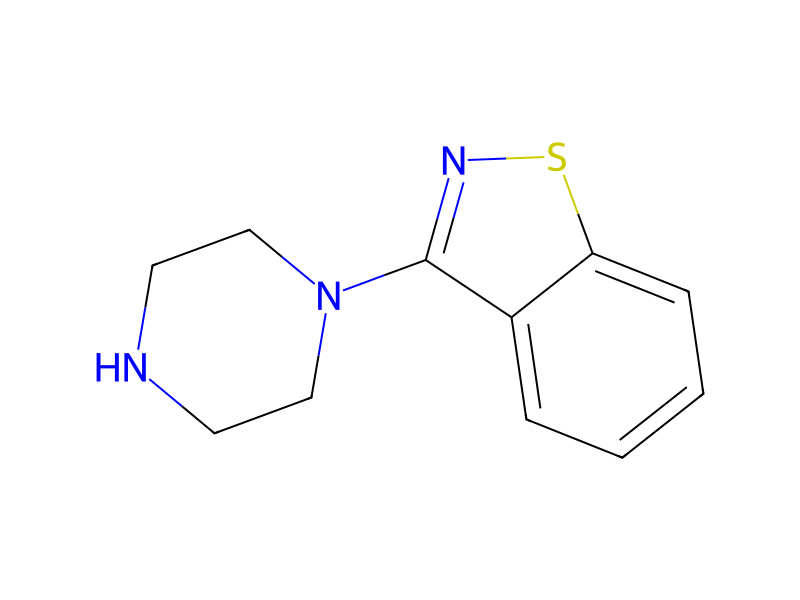
Piperazine → 3-(1-Piperazinyl)-1,2-benzisothiazole
Reaction equation

[NH:1]1[CH2:6][CH2:5][NH:4][CH2:3][CH2:2]1.C([C:9]1[CH:14]=[CH:13][CH:12]=[CH:11][C:10]=1[S:15][N:16]1[CH2:21]CNCC1)#N>C(O)(C)C>[N:1]1([C:21]2[C:11]3[CH:12]=[CH:13][CH:14]=[CH:9][C:10]=3[S:15][N:16]=2)[CH2:6][CH2:5][NH:4][CH2:3][CH2:2]1Participants
4
Reactant 2


Product 1
Reagents, catalysts & solvents 1

Conditions
- Temperature
- 90 °C
Procedure
Anhydrous piperazine (17.2 g, 0.20 mol) and isopropanol (3.0 mL) were charged to a round bottom flask equipped with a mechanical stirrer, thermometer, condenser topped with a nitrogen inlet, and an addition tunnel. Once the flask was purged and then maintained under nitrogen, the mixture was heated to 90° C. to afford a solution. A solution of 1-(2-cyanophenylthio)piperazine (4.38 g, 20.0 mmol) in isopropanol (2.0 mL) was slowly added to the warm piperazine solution over 1 hour. Once the addition was complete, the solution was heated to reflux (118° C.) for 24 hours. The reddish solution was cooled to room temperature and then analyzed by HPLC. 3-(1-Piperazinyl)-1,2-benzisothiazole was formed in 55% yield by HPLC assay.
Workup
- customequipped with a mechanical stirrer
- customthermometer, condenser topped with a nitrogen inlet
- customOnce the flask was purged
- temperaturemaintained under nitrogen
- customto afford a solution
- additionOnce the addition
- temperaturethe solution was heated
- temperatureto reflux (118° C.) for 24 hours
- temperatureThe reddish solution was cooled to room temperature
Sources & evidence
- ORD record
- ord-01a74e72d2ac4f559765f0cd34ac33ec
- Source dataset
- uspto-grants-2000_08
- Patent number
- US06111105
Reaction notes
Loading…