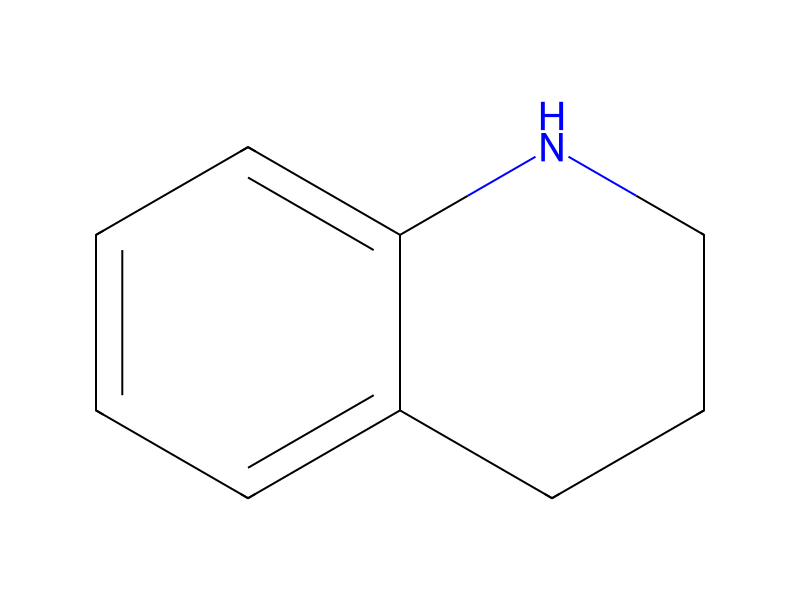
1,2,3,4-Tetrahydroquinoline → 4-Bromo-3-(3,4-dihydro-2H-quinoline-1-carbonyl)-benzonitrile
Reaction equation

[Br:1][C:2]1[CH:10]=[CH:9][C:8]([C:11]#[N:12])=[CH:7][C:3]=1[C:4]([OH:6])=O.[NH:13]1[C:22]2[C:17](=[CH:18][CH:19]=[CH:20][CH:21]=2)[CH2:16][CH2:15][CH2:14]1.C(N(C(C)C)C(C)C)C.[I-].ClC1C=CC=C[N+]=1C.C([O-])(O)=O.[Na+]>ClCCl>[Br:1][C:2]1[CH:10]=[CH:9][C:8]([C:11]#[N:12])=[CH:7][C:3]=1[C:4]([N:13]1[C:22]2[C:17](=[CH:18][CH:19]=[CH:20][CH:21]=2)[CH2:16][CH2:15][CH2:14]1)=[O:6]Participants
Reactant 5




Product 1

Reagents, catalysts & solvents 1

Procedure
To a solution of 2-bromo-5-cyano-benzoic acid (0.50 g, 2.12 mmol, 1.0 equiv; [CAS RN 845616-12-8]) in dichloromethane (5 mL) was added 1,2,3,4-tetrahydro-quinoline (0.35 g, 330 μL, 2.66 mmol, 1.2 equiv; [CAS RN 635-46-1]), N-ethyldiisopropylamine (1.43 g, 1.88 mL, 11.06 mmol, 5.0 equiv; [CAS RN 7087-68-5]) and 2-chloro-1-methylpyridinium iodide (0.68 g, 2.66 mmol, 1.2 equiv; [CAS RN 14338-32-0]). The reaction mixture was stirred at rt over the weekend. To the residue was added a sat. solution of NaHCO3 (100 mL) and the solution extracted with dichloromethane (3×50 mL). The combined organic phases were dried over Na2SO4 and the product purified by silica column chromatography using a MPLC system (CombiFlash Companion, Isco Inc.) eluting with a gradient of toluene/acetone affording 0.35 g (46%) of the title compound as a light yellow solid. MS (ISP): 341.1 [M+H]+.
Workup
- extractionthe solution extracted with dichloromethane (3×50 mL)
- dry with materialThe combined organic phases were dried over Na2SO4
- customthe product purified by silica column chromatography
- washeluting with a gradient of toluene/acetone affording 0.35 g (46%) of the title compound as a light yellow solid
Sources & evidence
- ORD record
- ord-f26cbf6ce8454415b70c4a85f3ed7581
- Source dataset
- uspto-grants-2012_11
- Patent number
- US08309734B2
Reaction notes
Loading…