Cesium carbonate → HCID 67210992, compound
Reaction equation

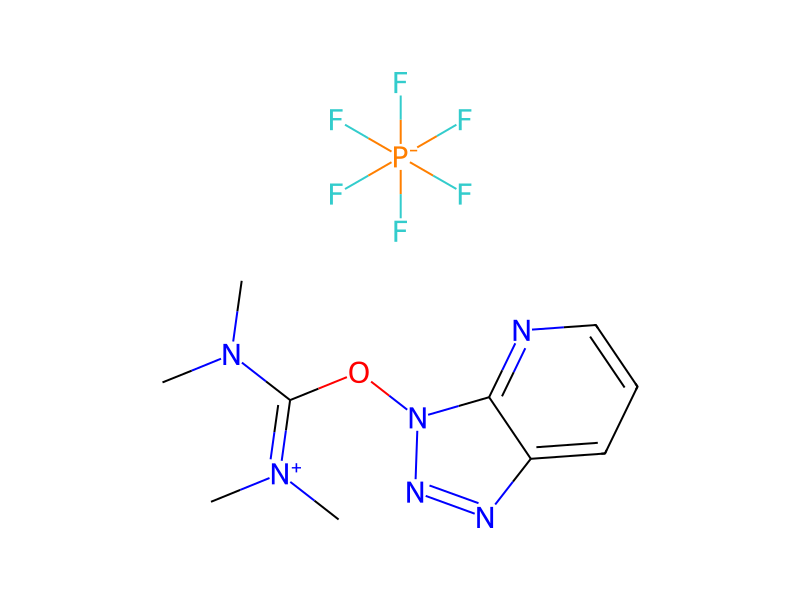
[C:1](=[O:4])([O-])[O-:2].[Cs+].[Cs+].[F:7][C:8]1[CH:13]=[CH:12][C:11]([C:14]2[O:15][C:16]3[CH:27]=[C:26]([N+:28]([O-:30])=[O:29])[C:25](OS(C(F)(F)F)(=O)=O)=[CH:24][C:17]=3[C:18]=2C(OCC)=O)=[CH:10][CH:9]=1.B([C:42]1[CH:43]=[C:44]([CH:48]=[CH:49][CH:50]=1)[C:45](O)=[O:46])(O)O.CN(C(ON1N=N[C:61]2C=CC=N[C:60]1=2)=[N+](C)C)C.F[P-](F)(F)(F)(F)F.[C:75]1([C:81]([NH2:84])([CH3:83])[CH3:82])[CH:80]=[CH:79][CH:78]=[CH:77][CH:76]=1.CCN(C(C)C)C(C)C>CCOC(C)=O.C1C=CC([P]([Pd]([P](C2C=CC=CC=2)(C2C=CC=CC=2)C2C=CC=CC=2)([P](C2C=CC=CC=2)(C2C=CC=CC=2)C2C=CC=CC=2)[P](C2C=CC=CC=2)(C2C=CC=CC=2)C2C=CC=CC=2)(C2C=CC=CC=2)C2C=CC=CC=2)=CC=1.O.O1CCOCC1>[F:7][C:8]1[CH:9]=[CH:10][C:11]([C:14]2[O:15][C:16]3[CH:27]=[C:26]([N+:28]([O-:30])=[O:29])[C:25]([C:42]4[CH:50]=[CH:49][CH:48]=[C:44]([C:45](=[O:46])[NH:84][C:81]([C:75]5[CH:80]=[CH:79][CH:78]=[CH:77][CH:76]=5)([CH3:83])[CH3:82])[CH:43]=4)=[CH:24][C:17]=3[C:18]=2[C:1]([O:2][CH2:60][CH3:61])=[O:4])=[CH:12][CH:13]=1Participants
Reactant 6





Product 1

Reagents, catalysts & solvents 4




Conditions
- Temperature
- 90 °C
Procedure
Step 1: cesium carbonate (143 mg, 0.440 mmol) was added to Pd(Ph3P)4 (17 mg, 0.015 mmol), ethyl 2-(4-fluorophenyl)-6-nitro-5-(trifluoromethylsulfonyloxy)benzofuran-3-carboxylate (140 mg, 0.293 mmol), 3-boronobenzoic acid (73 mg, 0.440 mmol). Dioxane (2.5 mL) and water (500 μL) was added at rt. The reaction was degassed 3× and heated to 90° C. overnight. It was allowed to cool. The mixture was diluted with EtOAc and washed with 1M HCl, and sat NaCl. The organic phase was dried over Na2SO4, filtered and concentrated. Step 2: The residue was diluted with DMF and treated with HATU (167 mg, 0.440 mmol), 2-phenylpropan-2-amine (60 mg, 0.440 mmol), and DIEA (154 μL, 0.880 mmol) and allowed to stir at rt overnight. The mixture was diluted with EtOAc and washed with sat NaHCO3, and sat NaCl. The organic phase was dried over Na2SO4, filtered and concentrated and purified on silica gel (Biotage, EtOAc/hexanes gradient, fraction collection at λ=254 nm) to give ethyl 2-(4-fluorophenyl)-6-nitro-5-(3-(2-phenylpropan-2-ylcarbamoyl)phenyl)benzofuran-3-carboxylate. (LC-MS retention time: 1.97 min; m/z (MH+): 567. LC data was recorded on a Shimadzu LC-10AS liquid chromatograph equipped with a Waters XBridge 5 u C18 4.6×50 mm column using a SPD-10AV UV-Vis detector at a detector wave length of 220 nM. The elution conditions employed a flow rate of 5 ml/min, a gradient of 100% solvent A/0% solvent B to 0% solvent A/100% solvent B, a gradient time of 2 min, a hold time of 1 min, and an analysis time of 3 min where solvent A was 5% acetonitrile/95% H2O/10 mM ammonium acetate and solvent B was 5% H2O/95% acetonitrile/10 mM ammonium acetate. MS data was determined using a Micromass Platform for LC in electrospray mode) Step 3: This material was treated with NaOH (1 mL, 1.000 mmol) in ethanol (2.93 mL) at 60° C. for 2 hr then allowed to stir overnight while cooling to rt. The reaction was heated to 60° C. for 3 hrs. The mixture was diluted with EtOAc and washed with 1M HCl, and sat NaCl. The organic phase was dried over Na2SO4, filtered and concentrated. Step 4: EDC (58 mg, 0.301 mmol), methanamine (1 mL, 2.000 mmol), 1-hydroxy-7-azabenzotriazole (38 mg, 0.276 mmol), DIEA (92 μL, 0.526 mmol) was added to the residue in DCE (2.5 mL) at rt. It was allowed to stir for 3 days. The slurry had gone into solution over that period of time. The crude reaction was purified on silica gel (Biotage, EtOAc/hexanes gradient, fraction collection at λ=254 nm) to give the titled compound (112 mg, 81%). 1H NMR (500 MHz, CD3OD) δ ppm 8.32 (1H, s), 7.97-8.06 (2H, m), 7.82-7.90 (2H, m), 7.75 (1H, s), 7.47-7.56 (2H, m), 7.45 (2H, d, J=7.32 Hz), 7.31 (4H, t, J=8.09 Hz), 7.18 (1H, t, J=7.32 Hz), 2.94 (3H, s), 1.77 (6H, s). LC-MS retention time: 3.10 min; m/z (MH+): 552. LC data was recorded on a Shimadzu LC-10AS liquid chromatograph equipped with a Phenomenex-Luna 10 u C18 3.0×50 mm column using a SPD-10AV UV-Vis detector at a detector wave length of 220 nM. The elution conditions employed a flow rate of 5 ml/min, a gradient of 100% solvent A/0% solvent B to 0% solvent A/100% solvent B, a gradient time of 3 min, a hold time of 1 min, and an analysis time of 4 min where solvent A was 10% MeOH/90% H2O/0.1% trifluoroacetic acid and solvent B was 10% H2O/90% MeOH/0.1% trifluoroacetic acid. MS data was determined using a Micromass Platform for LC in electrospray mode. Additional HPLC method: Solvent A=5% CH3CN/95% H2O/0.1% TFA, Solvent B=95% CH3CN/5% H2O/0.1% TFA, Start % B=10, Final % B=100, Gradient time=15 min, Stop time=18 min, Flow Rate=1 ml/min. Column: Waters Sunfire C-18, 4.6×150 mm, 3.5 μm, Rt=14.12 min, purity=96%; Column: Waters Xbridge Phenyl column 4.6×150 mm, 3.5 μm, Rt=12.98 min, purity=97%.
Workup
- customThe reaction was degassed 3×
- temperatureto cool
- additionThe mixture was diluted with EtOAc
- washwashed with 1M HCl
- dry with materialThe organic phase was dried over Na2SO4
- filtrationfiltered
- concentrationconcentrated
- additionStep 2: The residue was diluted with DMF
- washwashed
- dry with materialThe organic phase was dried over Na2SO4
- filtrationfiltered
- concentrationconcentrated
- custompurified on silica gel (Biotage, EtOAc/hexanes gradient, fraction collection at λ=254 nm)
Sources & evidence
- ORD record
- ord-fbedfc9744da4a4db3e8cd7852285ce8
- Source dataset
- uspto-grants-2012_11
- Patent number
- US08309558B2
Reaction notes
Loading…