Sorbitol → HCID 86586928, compound
Reaction equation

[C:1](=[O:4])([OH:3])[O-:2].[Na+:5].[OH:6][CH2:7][C@@H:8]([C@H:10]([C@@H:12]([C@@H:14]([CH2:16][OH:17])[OH:15])[OH:13])[OH:11])[OH:9]>O>[C:1](=[O:2])([OH:4])[O-:3].[Na+:5].[OH:17][CH2:16][C@@H:14]([C@H:12]([C@@H:10]([C@@H:8]([CH2:7][OH:6])[OH:9])[OH:11])[OH:13])[OH:15]Participants
Reactant 2
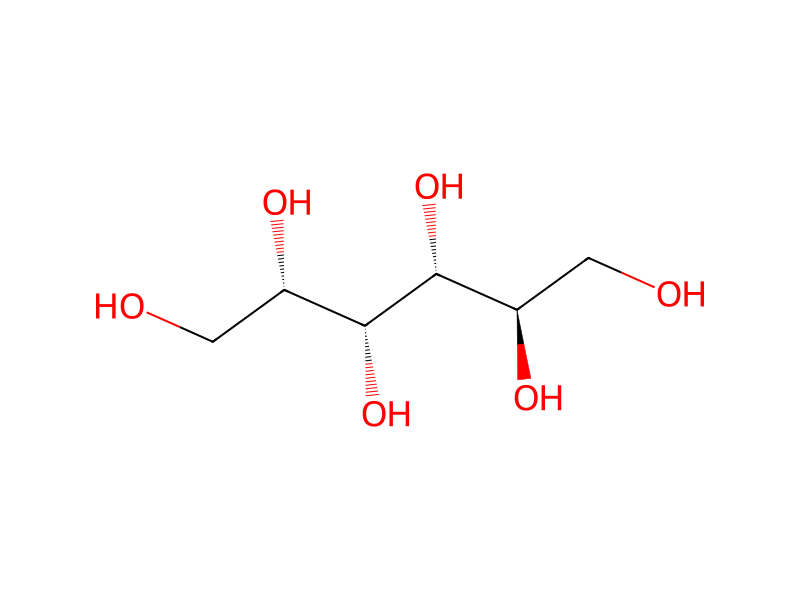

Product 1

Reagents, catalysts & solvents 1

Procedure
147 g (1.75 moles) of sodium bicarbonate, 540 g of water, and 390 g of a 70% sorbitol solution (i.e. 273 g of 100% sorbitol and 170 g of water) were mixed. 306 g (1.5 moles) of aluminum iso-propoxide, heated to 100° C., then were added to the mixture and stirred for 2 hours. The resulting precipitate was isolated by vacuum filtration. Roughly half the batch filtered rather well. The filtered liquid and unfiltered solid were recombined to prevent loss of sorbitol, air dried, and then oven dried at 100° C. overnight. A 5% (w/w) aqueous suspension of the material then was prepared, and stirred for about 30 minutes with gentle heating in order to ensure complete dispersion. The results are summarized in Table 1, and are as follows: ANC, 0.677; Appearance, translucent; Stability, excellent; Grittiness, none; Evaluation, acceptable.
Workup
- additionwere added to the mixture
- customThe resulting precipitate was isolated by vacuum filtration
- filtrationRoughly half the batch filtered rather well
- customdried
- customoven dried at 100° C. overnight
- additionA 5% (w/w) aqueous suspension of the material
- customthen was prepared
- stirringstirred for about 30 minutes
- temperaturewith gentle heating in order
Sources & evidence
- ORD record
- ord-5734e67c96844d9ead455f0cf66ccc8f
- Source dataset
- uspto-grants-2004_07
- Patent number
- US06767559B2
Reaction notes
Loading…