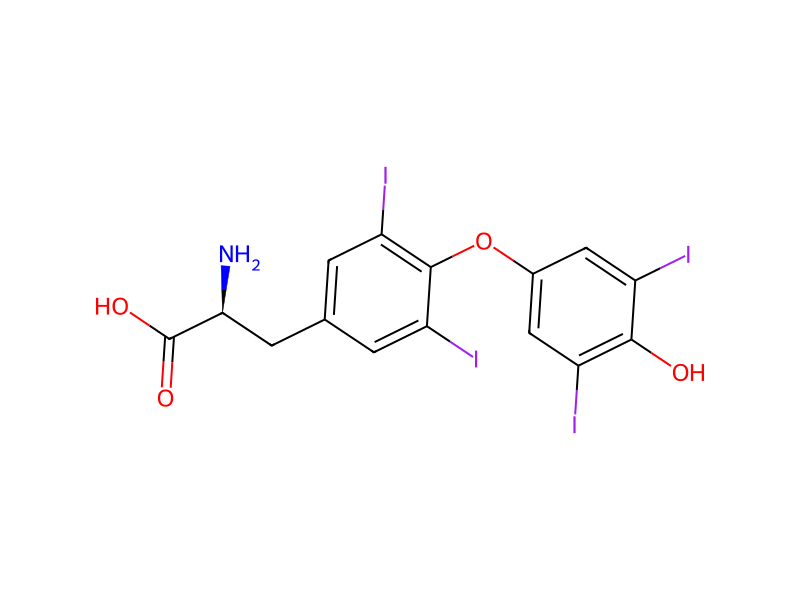
Thyroxine → Methyl thyroxinate hydrochloride
Reaction equation

[NH2:1][C@H:2]([C:22]([OH:24])=[O:23])[CH2:3][C:4]1[CH:11]=[C:9]([I:10])[C:8]([O:12][C:13]2[CH:20]=[C:18]([I:19])[C:17]([OH:21])=[C:15]([I:16])[CH:14]=2)=[C:6]([I:7])[CH:5]=1.[CH3:25]O.[ClH:27]>>[ClH:27].[NH2:1][C@H:2]([C:22]([O:24][CH3:25])=[O:23])[CH2:3][C:4]1[CH:5]=[C:6]([I:7])[C:8]([O:12][C:13]2[CH:14]=[C:15]([I:16])[C:17]([OH:21])=[C:18]([I:19])[CH:20]=2)=[C:9]([I:10])[CH:11]=1Participants
3


Procedure
Thyroxine (1 g) was dissolved in the methanol/HCl, to which molecular sieve was added, and the mixture was left at room temperature overnight. The ester precipitates out with a yield of above 90%. After filtration, the product was washed with acetone and stored in a vacuum desiccator until use.
Workup
- additionwas added
- customThe ester precipitates out with a yield of above 90%
- filtrationAfter filtration
- washthe product was washed with acetone
Sources & evidence
- ORD record
- ord-d6281931c4fc4c948c88050d3cce5aa0
- Source dataset
- uspto-grants-1992_09
- Patent number
- US05149630
Reaction notes
Loading…