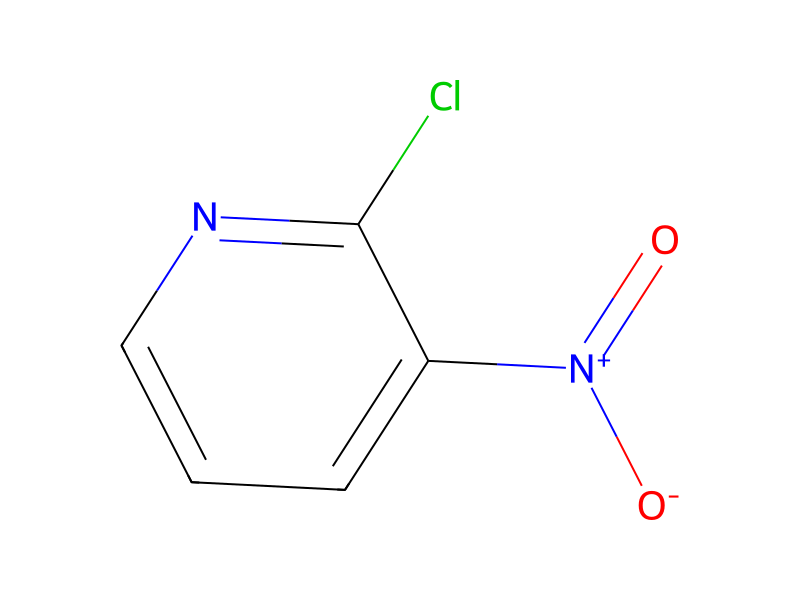
2-Chloro-3-nitropyridine → N-(4-Methylphenyl)-3-nitropyridin-2-amine
Reaction equation

Cl[C:2]1[C:7]([N+:8]([O-:10])=[O:9])=[CH:6][CH:5]=[CH:4][N:3]=1.C1(C)C=CC=C[C:12]=1[C:17]1[CH:23]=[CH:22][C:20]([NH2:21])=[CH:19][CH:18]=1.C(N(C(C)C)CC)(C)C>O1CCOCC1.C(OCC)(=O)C>[N+:8]([C:7]1[C:2]([NH:21][C:20]2[CH:22]=[CH:23][C:17]([CH3:12])=[CH:18][CH:19]=2)=[N:3][CH:4]=[CH:5][CH:6]=1)([O-:10])=[O:9]Participants





Conditions
- Temperature
- 80 °C
Procedure
2-chloro-3-nitropyridine (100 mg, 0.63 mmol) was dissolved in dioxane (4 mL) in a round bottom flask to which p-tolylaniline (68 mg, 0.63 mmol) was added followed by addition of diisopropylethylamine (0.22 mL). The reaction mixture was heated to 80° C. for 24 hours and stopped when complete as observed by LCMS. After cooling to room temperature, the solvent was removed under reduced pressure to afford an oily residue. The residue was dissolved in ethyl acetate (20 mL) and washed with water and brine (5 mL each respectively). The organic phase was separated and dried over Na2SO4. After filtration the solvent was removed under reduced pressure. The crude product was carried on to the next step without further purification. LCMS [M+H]: 230.
Workup
- additionwas added
- temperatureAfter cooling to room temperature
- customthe solvent was removed under reduced pressure
- customto afford an oily residue
- washwashed with water and brine (5 mL each respectively)
- customThe organic phase was separated
- dry with materialdried over Na2SO4
- filtrationAfter filtration the solvent
- customwas removed under reduced pressure
- customThe crude product was carried on to the next step without further purification
Sources & evidence
- ORD record
- ord-80c450600656478ab50c11292e3a316f
- Source dataset
- uspto-grants-2013_08
- Patent number
- US08501770B2
Reaction notes
Loading…