Water → Tert-butyl 4-(3-nitrophenyl)-1,2,3,6-tetrahydropyridine-1-carboxylate
Reaction equation

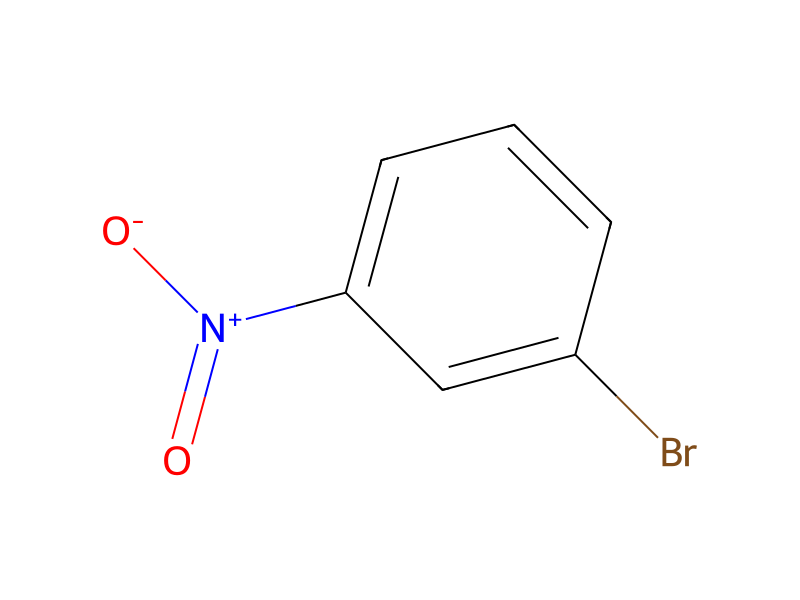
C1(P(C2C=CC=CC=2)C2C=CC=CC=2)C=CC=CC=1.Br[C:21]1[CH:26]=[CH:25][CH:24]=[C:23]([N+:27]([O-:29])=[O:28])[CH:22]=1.[C:30]([O:34][C:35]([N:37]1[CH2:42][CH:41]=[C:40](B2OC(C)(C)C(C)(C)O2)[CH2:39][CH2:38]1)=[O:36])([CH3:33])([CH3:32])[CH3:31].C(=O)([O-])[O-].[Na+].[Na+].O>C([O-])(=O)C.[Pd+2].C([O-])(=O)C.O1CCOCC1>[C:30]([O:34][C:35]([N:37]1[CH2:38][CH:39]=[C:40]([C:21]2[CH:26]=[CH:25][CH:24]=[C:23]([N+:27]([O-:29])=[O:28])[CH:22]=2)[CH2:41][CH2:42]1)=[O:36])([CH3:33])([CH3:31])[CH3:32]Participants
Reactant 5




Product 1

Reagents, catalysts & solvents 2


Conditions
- Temperature
- 80 °C
Procedure
186 a) To a round bottom flask was added palladium acetate (0.49 g, 2.2 mmol), triphenylphosphine (2.38 g, 9.06 mmol) and 1,4-dioxane (40 mL). The mixture was stirred for 15 minutes under an atmosphere of nitrogen until a bright yellow suspension resulted. 1-Bromo-3-nitro-benzene (3.0 g, 15 mmol), 4-(4,4,5,5-Tetramethyl-[1,3,2]dioxaborolan-2-yl)-3,6-dihydro-2H-pyridine-1-carboxylic acid tert-butyl ester (5.0 g, 16 mmol) and 1.50 M of sodium carbonate in water (24.5 mL, 36.8 mmol) were added. The mixture was stirred and heated at 80° C. for 24 hours. The mixture was cooled to room temperature and the volatiles were evaporated under reduced pressure. To the residue was added water (100 mL) then extracted with dichloromethane (3×50 mL). The combined organic layers were washed with water (2×50 mL) and saturated aqueous sodium chloride (50 mL), dried over magnesium sulfate, filtered and evaporated. The residue was purified via chromatography using an ISCO automated purification apparatus (silica gel column 80 g 5%→25% ethyl acetate:hexane solvent gradient). 4-(3-Nitro-phenyl)-3,6-dihydro-2H-pyridine-1-carboxylic acid tert-butyl ester was isolated as a yellow oil (3.95 g, 88%). 1H NMR (400 MHz, CDCl3, δ, ppm): 8.23 (s, 1H), 8.11 (d, J=8.1 Hz, 1H), 7.69 (d, J=7.7 Hz, 1H), 7.51 (t, J=7.8 Hz, 1H), 6.20 (br s, 1H), 4.12 (s, 2H), 3.70-3.65 (m, 2H), 2.56 (s, 2H), 1.50 (s, 9H). 186 b) To a solution of 4-(3-nitro-phenyl)-3,6-dihydro-2H-pyridine-1-carboxylic acid tert-butyl ester (0.50 g, 1.6 mmol) in dichloromethane (5 mL) was added m-CPBA 70-75% (0.57 g, 2.3 mmol). The mixture was stirred at room temperature for 18 hours. The reaction was quenched by the addition of saturated aqueous sodium thiosulfate solution followed by saturated aqueous sodium bicarbonate. The mixture was stirred for 1 hour. The mixture was extracted with dichloromethane (3×20 mL). The combined organic layers were dried over magnesium sulfate, filtered and evaporated. The residue was purified via chromatography (silica gel column 40 g and 10%→80% ethyl acetate:hexane solvent gradient). 6-(3-Nitro-phenyl)-7-oxa-3-aza-bicyclo[4.1.0]heptane-3-carboxylic acid tert-butyl ester was isolated as a yellow oil (0.335 g, 64%). 1H NMR (400 MHz, CDCl3, δ, ppm): 8.24 (s, 1H), 8.17 (d, J=7.9 Hz, 1H), 7.70 (d, J=7.8 Hz, 1H), 7.55 (t, J=7.9 Hz, 1H), 4.22-3.98 (m, 1H), 3.90-3.62 (m, 2H), 3.31-3.14 (m, 2H), 2.56-2.46 (m, 1H), 2.25-2.12 (m, 1H), 1.49 (s, 9H). MS=343 (M+Na)+. 186 c) (±)-(cis)-4-(3-Amino-phenyl)-3-hydroxy-piperidine-1-carboxylic acid tert-butyl ester was prepared from 6-(3-nitro-phenyl)-7-oxa-3-aza-bicyclo[4.1.0]heptane-3-carboxylic acid tert-butyl ester (0.335 g, 1.04 mmol) in a manner analogous to Example 111a. Product isolated as tan foam (0.0286 g, 94%). 1H NMR (400 MHz, CDCl3, δ, ppm): 7.13 (t, J=7.6 Hz, 1H), 6.72-6.50 (m, 3H), 4.31 (br s, 2H), 3.93 (br s, 1H), 3.03-2.93 (m, 1H), 2.87-2.69 (m, 2H), 2.28-2.15 (m, 1H), 1.64-1.52 (m, 4H), 1.48 (s, 9H). MS=315 (M+Na)+. 186 d) (±)-(cis)-3-Hydroxy-4-{3-[8-(4-methanesulfonyl-phenyl)-[1,2,4]triazolo[1,5-a]pyridin-2-ylamino]-phenyl}-piperidine-1-carboxylic acid tert-butyl ester was prepared from 2-chloro-8-(4-methanesulfonyl-phenyl)-[1,2,4]triazolo[1,5-a]pyridine (270.0 mg, 0.8773 mmol) and (±)-(cis)-4-(3-amino-phenyl)-3-hydroxy-piperidine-1-carboxylic acid tert-butyl ester (286.0 mg, 0.9782 mmol) with 2,2′-bis-dicyclohexylphosphanyl-biphenyl (77.0 mg, 0.141 mmol) as the ligand in a manner analogous to Example 2d. Product isolated as a yellow solid (0.313 g, 63%). MP=166-170° C. 1H NMR (400 MHz, CDCl3, δ, ppm): 8.51 (d, J=6.6 Hz, 1H), 8.23 (d, J=7.8 Hz, 2H), 8.09 (d, J=7.8 Hz, 2H), 7.66 (d, J=7.5 Hz, 1H), 7.53 (s, 1H), 7.48 (d, J=7.6 Hz, 1H), 7.33 (t, J=7.5 Hz, 1H), 7.03 (t, J=6.8 Hz, 1H), 6.96-6.90 (m, 2H), 4.35 (br s, 2H), 4.02 (br s, 1H), 3.11 (s, 3H), 3.08-3.00 (m, 1H), 2.90-2.80 (m, 2H), 2.36-2.24 (m, 1H), 1.72-1.60 (m, 2H), 1.50 (s, 9H). MS=586 (M+Na)+.
Workup
- customresulted
- stirringThe mixture was stirred
- temperatureThe mixture was cooled to room temperature
- customthe volatiles were evaporated under reduced pressure
- additionTo the residue was added water (100 mL)
- extractionthen extracted with dichloromethane (3×50 mL)
- washThe combined organic layers were washed with water (2×50 mL) and saturated aqueous sodium chloride (50 mL)
- dry with materialdried over magnesium sulfate
- filtrationfiltered
- customevaporated
- customThe residue was purified via chromatography
- custompurification apparatus (silica gel column 80 g 5%→25% ethyl acetate:hexane solvent gradient)
Sources & evidence
- ORD record
- ord-2621e46c277a490a9bffe33f68318a88
- Source dataset
- uspto-grants-2013_08
- Patent number
- US08501936B2
Reaction notes
Loading…