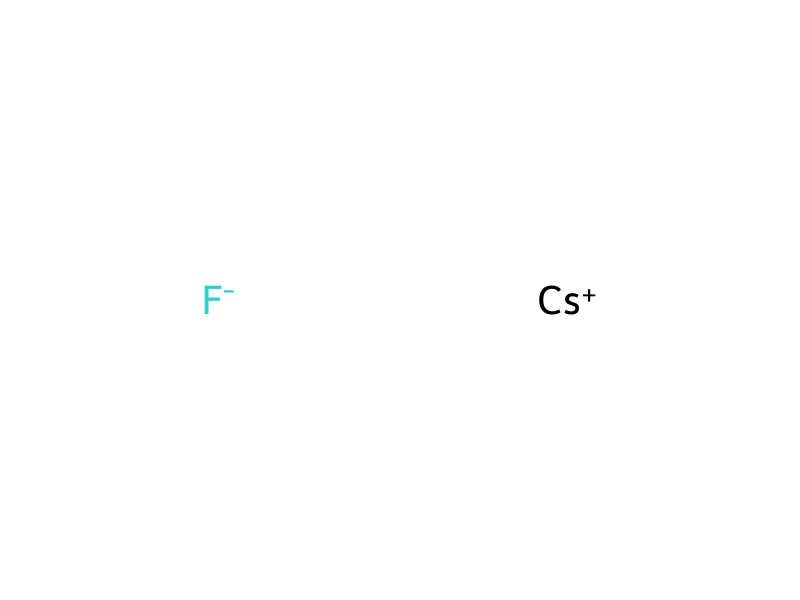
Cesium fluoride → 5-Bromo-2-(2,2-difluoropropyl)-1,2,3,4-tetrahydroisoquinoline
Reaction equation

[Br:1][C:2]1[CH:11]=[CH:10][CH:9]=[C:8]2[C:3]=1[CH2:4][CH2:5][N:6]([CH2:12][C:13](=O)[CH3:14])[CH2:7]2.C(N(S(F)(F)[F:22])CC)C.[F-:25].[Cs+].C([O-])(O)=O.[Na+]>C(Cl)Cl.C(O)(C(F)(F)F)=O>[Br:1][C:2]1[CH:11]=[CH:10][CH:9]=[C:8]2[C:3]=1[CH2:4][CH2:5][N:6]([CH2:12][C:13]([F:22])([F:25])[CH3:14])[CH2:7]2Participants
Reactant 4



Product 1

Reagents, catalysts & solvents 2


Procedure
To a solution of 1-(5-bromo-3,4-dihydroisoquinolin-2(1H)-yl)propan-2-one (962 mg, 3.59 mmol), diethylamino sulfur trifluoride (1.74 g, 10.8 ml) in DCM (12 ml) is added cesium fluoride (151 mg, 1 mmol) in small portions, then a few drops of TFA at room temperature. The mixture is stirred for 18 hours at room temperature. To this solution is added saturated aqueous NaHCO3 to quench the reaction. The aqueous layer is extracted with DCM (50 ml×3). The combined organic layers are washed with water, brine, dried over MgSO4 and concentrated. The residue is purified by silica gel flash chromatography, eluted with 20% ethyl acetate in hexanes to yield 5-Bromo-2-(2,2-difluoropropyl)-1,2,3,4-tetrahydroisoquinoline as a brown oil. LC-MS m/z: 291.1 (M+1).
Workup
- customat room temperature
- customto quench
- customthe reaction
- extractionThe aqueous layer is extracted with DCM (50 ml×3)
- washThe combined organic layers are washed with water, brine
- dry with materialdried over MgSO4
- concentrationconcentrated
- customThe residue is purified by silica gel flash chromatography
- washeluted with 20% ethyl acetate in hexanes
Sources & evidence
- ORD record
- ord-8c5cf11f0e3f4776b1ac734ecd27e39d
- Source dataset
- uspto-grants-2013_08
- Patent number
- US08507491B2
Reaction notes
Loading…