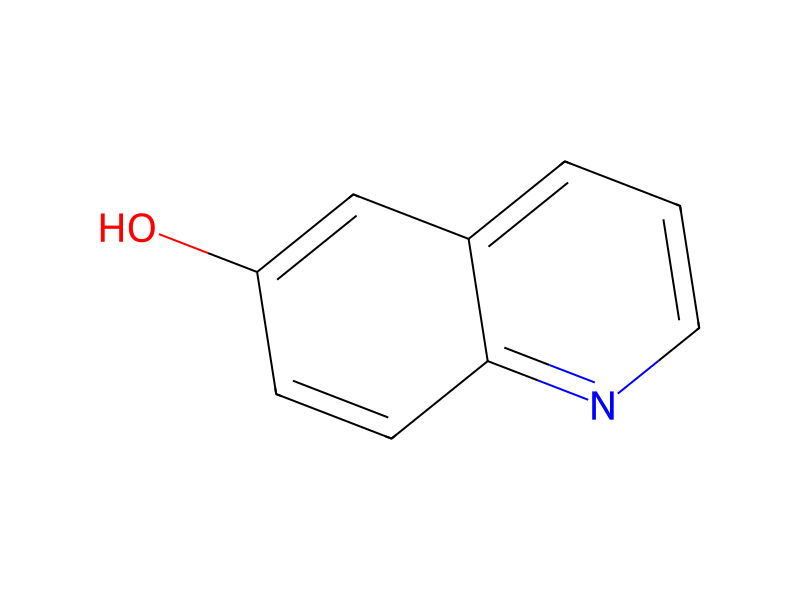
6-Hydroxyquinoline → 6-Quinolinyl trifluoromethanesulfonate
Reaction equation

[N:1]1[C:10]2[C:5](=[CH:6][C:7]([OH:11])=[CH:8][CH:9]=2)[CH:4]=[CH:3][CH:2]=1.[O:12](S(C(F)(F)F)(=O)=O)[S:13]([C:16]([F:19])([F:18])[F:17])(=O)=[O:14]>N1C=CC=CC=1>[N:1]1[C:10]2[C:5](=[CH:6][C:7]([O:11][S:13]([C:16]([F:19])([F:18])[F:17])(=[O:14])=[O:12])=[CH:8][CH:9]=2)[CH:4]=[CH:3][CH:2]=1Participants
4
Reactant 2

Product 1

Reagents, catalysts & solvents 1

Conditions
- Temperature
- 0 °C
Procedure
Quinolin-6-ol (2.9 g, 20 mmol) was dissolved in pyridine (30 mL). The mixture was cooled to 0° C. in an ice bath under nitrogen and Tf2O (4 mL, 24 mmol) was added to the reaction mixture slowly. The reaction mixture was stirred at room temperature for 5 hours, before partitioning between dichloromethane (50 mL) and saturated aqueous NaHCO3 (50 mL). The organic phase was separated and washed with brine (5×30 mL). The organic phase was dried over Na2SO4, filtered and concentrated in vacuo. The residue was purified by column chromatography to give 3.9 g of trifluoromethanesulfonic acid quinolin-6-yl ester as a brown oil (70% yield).
Workup
- custombefore partitioning between dichloromethane (50 mL) and saturated aqueous NaHCO3 (50 mL)
- customThe organic phase was separated
- washwashed with brine (5×30 mL)
- dry with materialThe organic phase was dried over Na2SO4
- filtrationfiltered
- concentrationconcentrated in vacuo
- customThe residue was purified by column chromatography
Sources & evidence
- ORD record
- ord-4bb6094a554c458e93c50cd0269b0d4f
- Source dataset
- uspto-grants-2013_08
- Patent number
- US08507489B2
Reaction notes
Loading…