Triethylamine → HCID 59674059, compound
Reaction equation

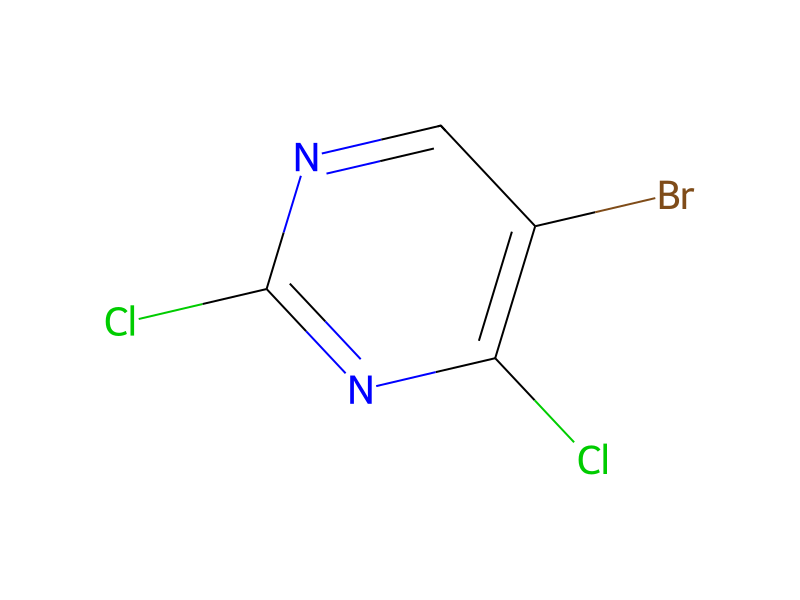
Cl.[NH2:2][C@H:3]([CH2:7][O:8][CH3:9])[C@H:4]([OH:6])[CH3:5].C(N(CC)CC)C.[Br:17][C:18]1[C:19](Cl)=[N:20][C:21]([Cl:24])=[N:22][CH:23]=1>C(#N)C>[Br:17][C:18]1[C:19]([NH:2][C@H:3]([CH2:7][O:8][CH3:9])[C@H:4]([OH:6])[CH3:5])=[N:20][C:21]([Cl:24])=[N:22][CH:23]=1Participants
Reactant 3


Product 1

Reagents, catalysts & solvents 1

Procedure
311 mg (2.6 mmol) of (2R,3R)-3-amino-4-methoxy-butan-2-ol hydrochloride (production according to A. I. Meyers, D. Hoyer, Tet. Lett. 1985, 26, 4687) in 2 ml of acetonitrile is mixed with 0.28 ml of triethylamine and shaken. It is filtered, and the filter cakes are washed with 2 ml of acetonitrile. The filtrate is added in drops to a solution of 455 mg (2.0 mmol) of 5-bromo-2,4dichloro-pyrimidine in 26 ml of acetonitrile at −30° C. By removal of the cooling bath, it is slowly heated to room temperature while being stirred. After 16 hours, the solvent is drawn off in a rotary evaporator, and the remaining residue is purified by chromatography (hexane/ethyl acetate: 4:1-1:1). 509 mg (1.6 mmol, corresponding to 80% of theory) of the product is obtained.
Workup
- filtrationIt is filtered
- washthe filter cakes are washed with 2 ml of acetonitrile
- customBy removal of the cooling bath, it
- stirringwhile being stirred
- customthe solvent is drawn off in a rotary evaporator
- customthe remaining residue is purified by chromatography (hexane/ethyl acetate: 4:1-1:1)
- custom509 mg (1.6 mmol, corresponding to 80% of theory) of the product is obtained
Sources & evidence
- ORD record
- ord-f2ab68db231843c69d6a1afd9503e40b
- Source dataset
- uspto-grants-2013_08
- Patent number
- US08507510B2
Reaction notes
Loading…