Triethylamine → HCID 66898703, compound
Reaction equation

Cl[C:2]1[C:3]2[C:10]([CH3:11])=[CH:9][NH:8][C:4]=2[N:5]=[CH:6][N:7]=1.[CH:12]12[N:19]([C:20]([O:22][C:23]([CH3:26])([CH3:25])[CH3:24])=[O:21])[CH:16]([CH2:17][CH2:18]1)[CH2:15][NH:14][CH2:13]2.C(N(CC)CC)C>C(O)(C)C>[CH3:11][C:10]1[C:3]2[C:2]([N:14]3[CH2:13][CH:12]4[N:19]([C:20]([O:22][C:23]([CH3:26])([CH3:25])[CH3:24])=[O:21])[CH:16]([CH2:17][CH2:18]4)[CH2:15]3)=[N:7][CH:6]=[N:5][C:4]=2[NH:8][CH:9]=1Participants
5
Reactant 3

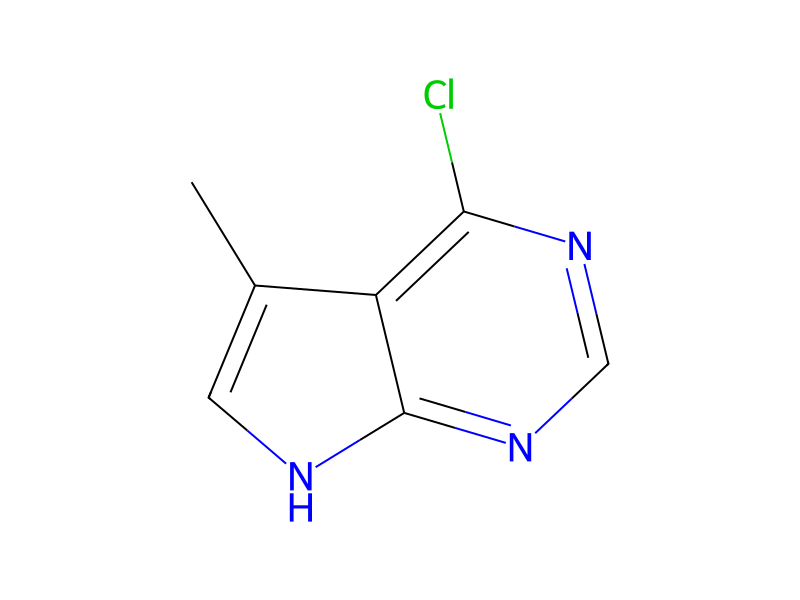

Product 1

Reagents, catalysts & solvents 1

Conditions
- Temperature
- 180 °C
Procedure
To a solution of 4-chloro-5-methyl-7H-pyrrolo[2,3-d]pyrimidine (25 mg, 0.15 mmol) and tert-butyl 3,8-diazabicyclo[3.2.1]octane-8-carboxylate (30 mg, 0.14 mmol) in isopropanol (2 ml) was added triethylamine (36 μL, 0.26 mmol). The reaction was heated at 180° C. for 30 min in the microwave, then concentrated under vacuum. The residue was purified by prep HPLC (Sunfire C18 30×50 mm, 10-90% H2O/MeOH w/0.01% TFA, 15 min, 35 ml/min, 220 nm) to give tert-butyl 3-(5-methyl-7H-pyrrolo[2,3-d]pyrimidin-4-yl)-3,8-diazabicyclo[3.2.1]octane-8-carboxylate (35 mg, 0.10 mmol, 66%).
Workup
- concentrationconcentrated under vacuum
- customThe residue was purified by prep HPLC (Sunfire C18 30×50 mm, 10-90% H2O/MeOH w/0.01% TFA, 15 min, 35 ml/min, 220 nm)
Sources & evidence
- ORD record
- ord-b199ed2d24bc48878a539810b0f0700c
- Source dataset
- uspto-grants-2013_08
- Patent number
- US08507672B2
Reaction notes
Loading…