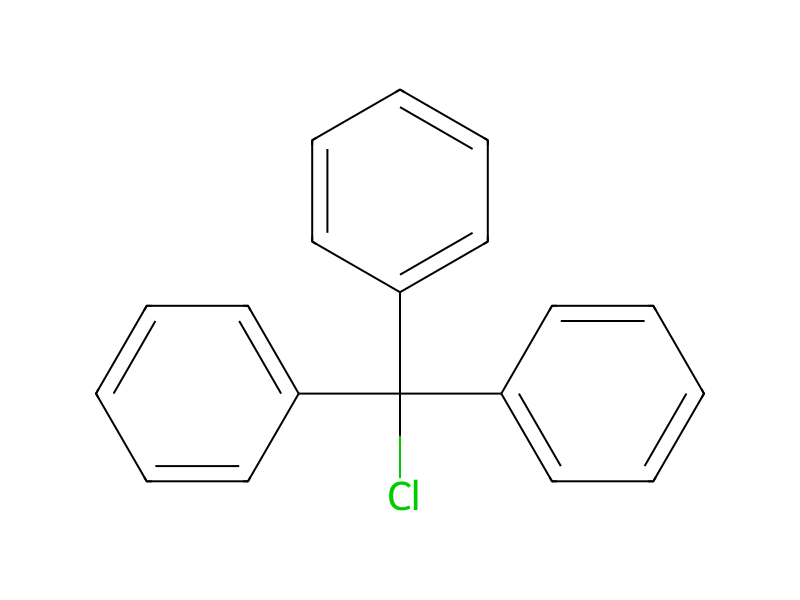
Trityl chloride → Methyl 2-tritylsulfanylacetate
Reaction equation

[C:1](Cl)([C:14]1[CH:19]=[CH:18][CH:17]=[CH:16][CH:15]=1)([C:8]1[CH:13]=[CH:12][CH:11]=[CH:10][CH:9]=1)[C:2]1[CH:7]=[CH:6][CH:5]=[CH:4][CH:3]=1.[C:21]([O:25][CH3:26])(=[O:24])[CH2:22][SH:23]>C1(C)C=CC=CC=1>[C:2]1([C:1]([C:14]2[CH:19]=[CH:18][CH:17]=[CH:16][CH:15]=2)([C:8]2[CH:13]=[CH:12][CH:11]=[CH:10][CH:9]=2)[S:23][CH2:22][C:21]([O:25][CH3:26])=[O:24])[CH:7]=[CH:6][CH:5]=[CH:4][CH:3]=1Participants
4
Reactant 2

Product 1

Reagents, catalysts & solvents 1

Procedure
A solution of trityl chloride (Aldrich) (5.0 g, 17.9 mmol) and methyl thioglycolate (2.1 mL, 23.3 mmol) in 50 mL of toluene is heated at reflux overnight. The reaction solution is cooled and concentrated in vacuo. The oily residue is crystallized from ethyl acetate/hexane to give 5.4 g (87%) of methyl [(triphenylmethyl)thio]acetate: melting point 111°-115° C.
Workup
- temperatureat reflux overnight
- temperatureThe reaction solution is cooled
- concentrationconcentrated in vacuo
- customThe oily residue is crystallized from ethyl acetate/hexane
Sources & evidence
- ORD record
- ord-34f8125248a44acb83a9b3b509b2b007
- Source dataset
- uspto-grants-1996_11
- Patent number
- US05571825
Reaction notes
Loading…