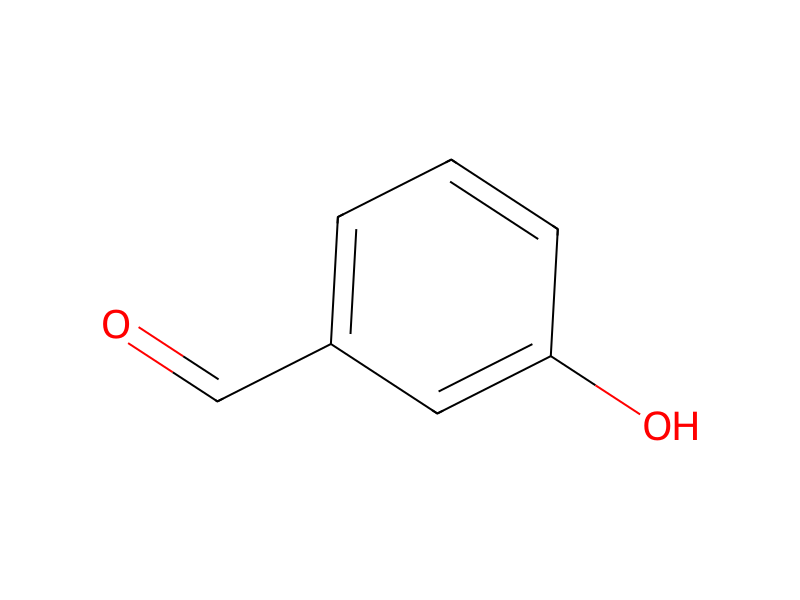
3-Hydroxybenzaldehyde → 3-(t-Butyldimethylsilyloxy)benzaldehyde
Reaction equation

[OH:1][C:2]1[CH:3]=[C:4]([CH:7]=[CH:8][CH:9]=1)[CH:5]=[O:6].[Si:10](Cl)([C:13]([CH3:16])([CH3:15])[CH3:14])([CH3:12])[CH3:11].N1C=CN=C1.O>CN(C)C=O>[Si:10]([O:1][C:2]1[CH:3]=[C:4]([CH:7]=[CH:8][CH:9]=1)[CH:5]=[O:6])([C:13]([CH3:16])([CH3:15])[CH3:14])([CH3:12])[CH3:11]Participants
6
Reactant 4



Product 1

Reagents, catalysts & solvents 1

Procedure
3-Hydroxybenzaldehyde (70 g, 0.57 mol), tert-butyldimethylsilyl chloride (92 g, 0.61 mol), and imidazole (92 g, 1.35 mol) were combined in dimethylformamide (250 mL). The mixture was stirred at room temperature, under nitrogen, for 1 hour. The solution was poured into water (1.5 L) and extracted with 2×500 mL petroleum ether (35°-60° C. boiling range). The organic solution was washed with saturated sodium chloride solution (100 mL), dried over magnesium sulfate, treated with silica gel (20 g), filtered, and concentrated in vacuo. The residue was dried further under high vacuum to yield (126.6 g (94%) of the air and light-sensitive 3-((tert-butyldimethylsilyl)oxy)benzaldehyde as an amber oil.
Workup
- extractionextracted with 2×500 mL petroleum ether (35°-60° C. boiling range)
- washThe organic solution was washed with saturated sodium chloride solution (100 mL)
- dry with materialdried over magnesium sulfate
- additiontreated with silica gel (20 g)
- filtrationfiltered
- concentrationconcentrated in vacuo
- customThe residue was dried further under high vacuum
Sources & evidence
- ORD record
- ord-3fd8a93ec69b418ba90b0c12c49be2b3
- Source dataset
- uspto-grants-1996_11
- Patent number
- US05574159
Reaction notes
Loading…