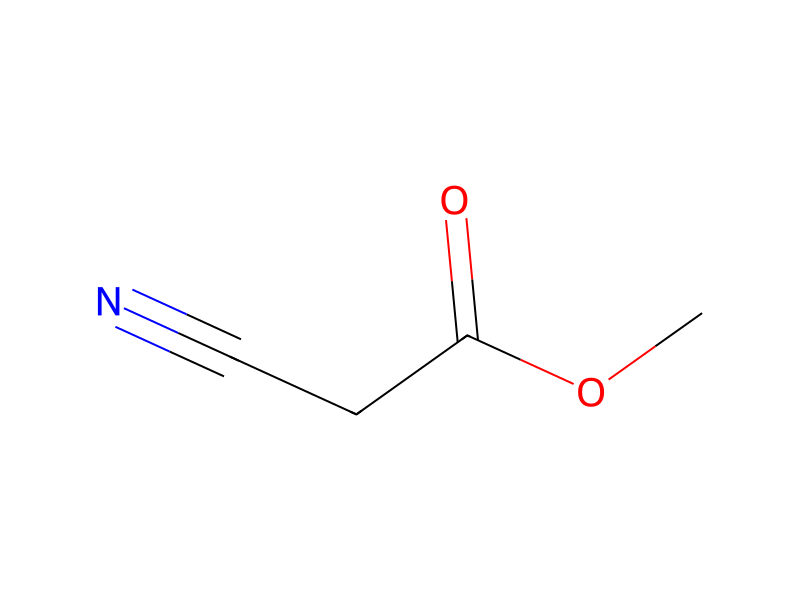
Methyl cyanoacetate → HCID 178510519, compound
Reaction equation

[Cl:1][C:2]1[CH:13]=[C:6]2[C:7]([O:9][C:10](=[O:12])[NH:11][C:5]2=[CH:4][CH:3]=1)=O.[C:14]([CH2:16]C(OC)=O)#[N:15].C(N(CC)CC)C>CN(C=O)C>[Cl:1][C:2]1[CH:13]=[C:6]2[C:5](=[CH:4][CH:3]=1)[N:11]=[C:10]([OH:12])[C:16]([C:14]#[N:15])=[C:7]2[OH:9]Participants
Reactant 3


Product 1

Reagents, catalysts & solvents 2

Conditions
- Temperature
- 90 °C
Procedure
A 300 ml, three neck flask, equipped as described in Example 1, was charged with 39.5 g 5-chloroisatoic anhydride (molecular weight 198.5:assay 95 percent), 21.8 g methyl cyanoacetate, 150 ml triethylamine and four drops of DMF. Agitation was commenced, and continued until reaction was discontinued. A slight exotherm caused the temperature of the reaction mixture to increase from 20° C. to about 38° C., and to remain at about 38° C. for approximately one hour, during which time there was a steady and vigorous evolution of gas. At the end of one hour the temperature began to drop, and the rate of gas evolution slowed as the consistency of the reaction mixture became jelly-like. The reaction mixture was then heated to a temperature of 90° C. and maintained at a temperature within the range of 85° to 90° C. for one-half hour. The heating to 90° C. occurred over a period of one-half hour. The temperature of the reaction mixture was then raised to approximately 100° C., and maintained at about such temperature for an additional 30 minutes. Gas evolution reached a maximum during the time that the reaction mixture was at a temperature between 85° and 100° C. and then gradually decreased and stopped. The reaction mixture became jelly-like and gummy during the time that the temperature was being maintained between 85° and 90° C.; to facilitate stirring a 20 ml addition of DMF was made when this occurred. After the reaction mixture had been maintained at approximately 100° C. for one-half hour, agitation was stopped and the reaction mixture separated into an upper colorless layer consisting mainly of triethylamine and a lower layer of a tan oil. The excess of triethylamine was recovered by distillation, after which the oily remainder was dissolved in 700 ml water and treated with 3 g activated charcoal at reflux. Concentrated hydrochloric acid at a temperature of 60° to 70° C. was then added to the beaker to bring the pH to 1.0 and to form a precipitate. The precipitate was recovered by filtration; the filter cake was washed with water, was reslurried in warm water, refiltered, and finally dried at 60° C. The yield was 39.34 g (93.9 percent of theory based upon the pure 5-chloro-isatoic anhydride charged) 6-chloro-3-cyano-2,4-dihydroxyquinoline, melting point 275°-277° C. Examination of the product by infrared spectroscopy and nuclear magnetic resonance indicated that it was of high purity.
Workup
- customA 300 ml, three neck flask, equipped
- customcontinued until reaction
- temperatureto increase from 20° C. to about 38° C.
- customAt the end of one hour
- temperaturemaintained at a temperature within the range of 85° to 90° C. for one-half hour
- waitThe heating to 90° C. occurred over a period of one-half hour
- temperatureThe temperature of the reaction mixture was then raised to approximately 100° C.
- temperaturemaintained at about such temperature for an additional 30 minutes
- customwas at a temperature between 85° and 100° C.
- temperaturewas being maintained between 85° and 90° C.
- temperatureAfter the reaction mixture had been maintained at approximately 100° C. for one-half hour
- customthe reaction mixture separated into an upper colorless layer
- distillationThe excess of triethylamine was recovered by distillation
- dissolutionafter which the oily remainder was dissolved in 700 ml water
- additiontreated with 3 g
- temperatureat reflux
- additionConcentrated hydrochloric acid at a temperature of 60° to 70° C. was then added to the beaker
- customto form a precipitate
- filtrationThe precipitate was recovered by filtration
- washthe filter cake was washed with water
- customfinally dried at 60° C
- additioncharged) 6-chloro-3-cyano-2,4-dihydroxyquinoline, melting point 275°-277° C
Sources & evidence
- ORD record
- ord-4743a8dfe7a14df7af49757fa991bbf4
- Source dataset
- uspto-grants-1982_12
- Patent number
- US04362876
Reaction notes
Loading…