Water → 1-bromo-4-[(1S)-1-isocyanatoethyl]benzene
Reaction equation

[C:1](=[O:4])(O)[O-].[Na+].O.[Br:7][C:8]1[CH:13]=[CH:12][C:11]([CH:14]([NH2:16])[CH3:15])=[CH:10][CH:9]=1.ClC(Cl)(OC(=O)OC(Cl)(Cl)Cl)Cl>ClCCl>[Br:7][C:8]1[CH:13]=[CH:12][C:11]([C@@H:14]([N:16]=[C:1]=[O:4])[CH3:15])=[CH:10][CH:9]=1Participants
Reactant 4

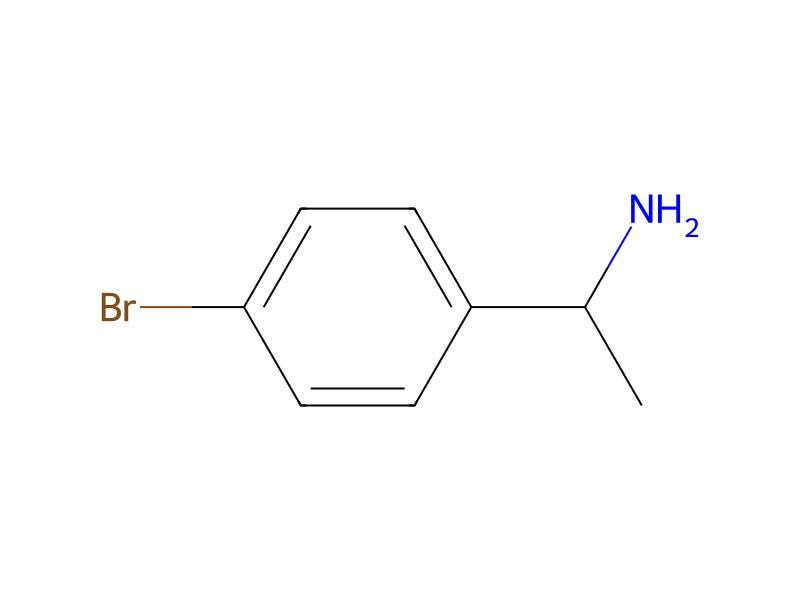


Product 1

Reagents, catalysts & solvents 1

Conditions
- Temperature
- 2.5 °C
Procedure
To a 10 L jacketed reactor was charged 241 g of sodium bicarbonate (2.87 mol, 2.30 equiv) and 5 L of deionized water. The resulting solution was agitated for 10-20 min, until the solids dissolved (homogeneous). To the clear solution was charged 250 g (1.25 mol, 1.00 equiv) of (S)-(+1-(4-bromophenyl)ethylamine as a solution in 1.00 L of dichloromethane. An additional 4 L of dichloromethane was charged to the reactor. The biphasic solution was agitated and cooled to Tint=2-3° C. Triphosgene (126 g, 424 mmol, 0.340 equiv) was charged to the reactor in approximately two equal portions ˜6 min apart. It should be noted that a slight exotherm was noted upon the addition of triphosgene. The resulting murky solution was agitated at Tint=2-5° C. for 30 min, at which point HPLC analysis indicates >99 A % conversion (220 nm). The dichloromethane layer was cut and dried with anhydrous sulfate. The resulting solution was passed through a celite plug and concentrated to ˜1.5 L which fine particles of a white solid developed. The solution was filtered and concentrated to a thick oil via reduced pressure to produce 239 g of 1-bromo-4-((S)-1-isocyanato-ethyl)-benzene (93.7 wt %, 79.4% yield). 1H-NMR spectroscopy (400 MHz, CD2Cl2) δ 7.53 (d, J=11.4 Hz, 2H), 7.26 (d, J=8.2 Hz, 2H), 4.80 (q, J=6.7 Hz, 1H), 1.59 (d, J=6.7 Hz, 3H). The material was used in Step 3 without further purification.
Workup
- dissolutiondissolved (homogeneous)
- stirringThe biphasic solution was agitated
- stirringThe resulting murky solution was agitated at Tint=2-5° C. for 30 min, at which point HPLC analysis
- dry with materialdried with anhydrous sulfate
- concentrationconcentrated to ˜1.5 L which fine particles of a white solid
- filtrationThe solution was filtered
- concentrationconcentrated to a thick oil via reduced pressure
Sources & evidence
- ORD record
- ord-ea6a5778777f4c10a1fc3929a29792a6
- Source dataset
- uspto-grants-2013_12
- Patent number
- US08598163B2
Reaction notes
Loading…