1,2-Dibromoethane → 7-bromo-2H,3H-[1,4]dioxino[2,3-b]pyridine
Reaction equation
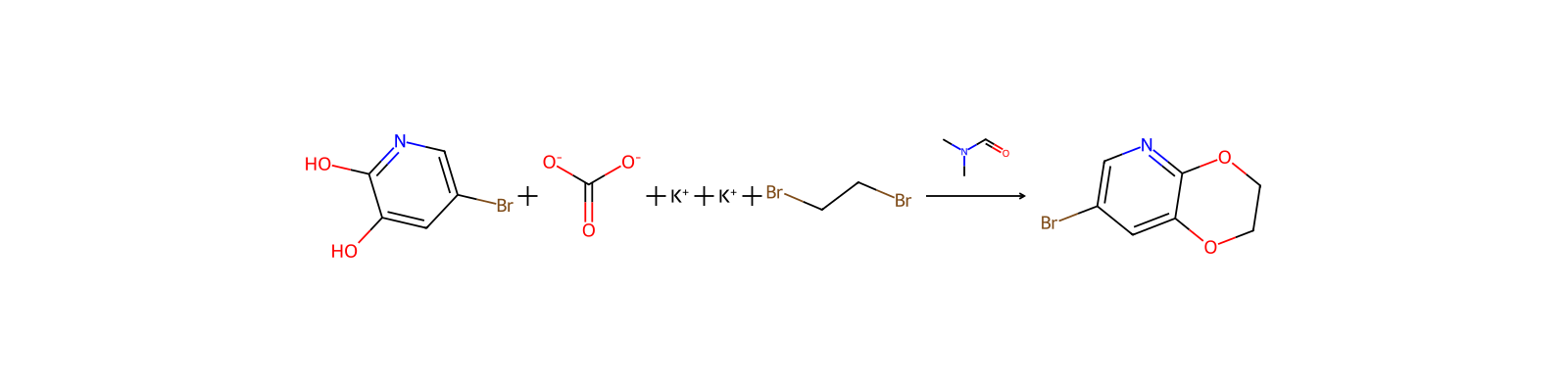
[Br:1][C:2]1[CH:3]=[C:4]([OH:9])[C:5]([OH:8])=[N:6][CH:7]=1.C([O-])([O-])=O.[K+].[K+].Br[CH2:17][CH2:18]Br>CN(C=O)C>[Br:1][C:2]1[CH:3]=[C:4]2[O:9][CH2:18][CH2:17][O:8][C:5]2=[N:6][CH:7]=1Participants
Reactant 3



Product 1

Reagents, catalysts & solvents 1

Conditions
- Temperature
- 100 °C
Procedure
To a suspension of 5-Bromo-pyridine-2,3-diol (10.0 g, 52.63 mmol, commercially available, CAS 34206-49-0) in DMF (150 mL) was added K2CO3 (21.78 g, 158 mmol) and 1,2-dibromo ethane (11.87 g, 63.2 mmol). The reaction mixture was heated to 100° C. for 5 h. The reaction mixture was cooled to rt and poured into ice cold water EtOAc was added and the phases were separated and the aq layer was extracted with more ethyl acetate. The combined organic layers was dried over anhydrous Na2SO4 and concentrated under vacuo to get the crude compound. The crude compound was purified by silica gel chromatography (eluent 10% ethyl acetate in petrol ether). Yield of 6-Bromo-[1,3]dioxolo[4,5-b]pyridine 2.2 g (18%) pure by 1H NMR (400 MHz, DMSO) δ 7.85 (d, 1H, J=2 Hz), 7.59 (d, 1H, J=2 Hz), 4.41 (m, 2H), 4.27 (m, 2H).
Workup
- temperatureThe reaction mixture was cooled to rt
- additionpoured into ice cold water EtOAc
- additionwas added
- customthe phases were separated
- extractionthe aq layer was extracted with more ethyl acetate
- dry with materialThe combined organic layers was dried over anhydrous Na2SO4
- concentrationconcentrated under vacuo
Sources & evidence
- ORD record
- ord-37427c407c714e46b0ff1f1f0cf4672f
- Source dataset
- uspto-grants-2013_12
- Patent number
- US08598213B2
Reaction notes
Loading…