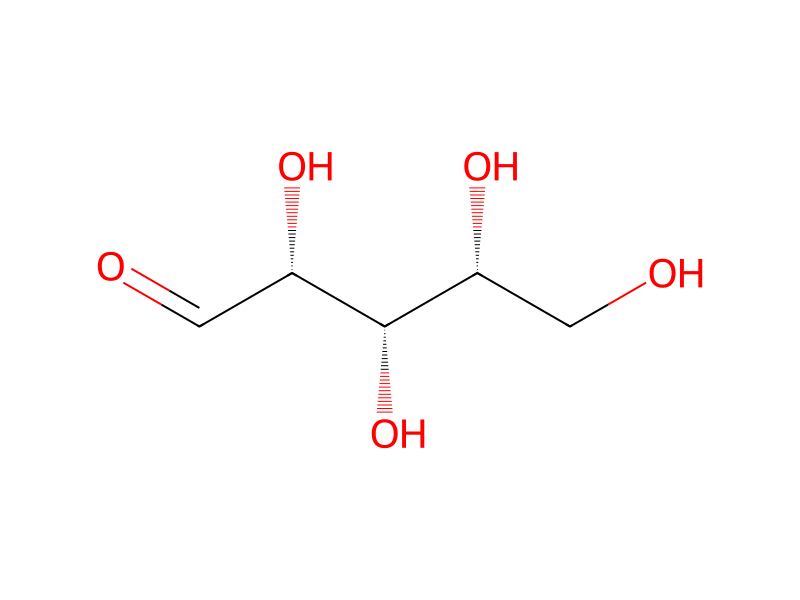
Ethanol → (2R,3S,4R,5R)-2,3,4,5,6-pentahydroxyhexanal
Reaction equation

[O:1]=[CH:2][C@@H:3]([C@H:5]([C@@H:7]([CH2:9][OH:10])[OH:8])[OH:6])[OH:4].[CH2:11]([OH:13])C>>[O:1]=[CH:2][C@@H:3]([C@H:5]([C@@H:7]([C@@H:9]([CH2:11][OH:13])[OH:10])[OH:8])[OH:6])[OH:4]Participants


Procedure
All strains used glucose efficiently; however, strains 22-1-12 and 14-2-6 achieved the highest ethanol levels, productivities, and fermentation efficiencies, while having the lowest residual sugar levels (Table 2, top). When cellobiose was provided as the carbon source, all strains performed poorly, but in these trials strains WT-2-1 and 22-1-1 performed slightly better than the other strains (Table 2, middle). The results using xylose as the carbon source showed that the strains performing best were 14-2-6 and 22-1-12 (Table 2, bottom). However, compared to the results with glucose (about 18 g/L ethanol), these strains produced only about 3 g/L on xylose, which is about 12% of the theoretical yield (25.6 g/L for xylose). Yet the fermentation efficiency was about 30%, indicating that less than half the consumed xylose was converted to ethanol. The fermentation efficiency of the mutagenized strain on the individual sugar substrates is compared graphically in FIG. 1B. Initial concentrations of all sugar carbon sources were 50 g/L. Theoretical ethanol yield for glucose is 50 g/L [(2×46)/180]=25.6 g/L; for cellobiose is 50 g/L [(4×46)/342]=26.9 g/L; and for xylose is 50 g/L [(10×46)/(6×150)]=25.6 g/L. Fermentation efficiency was calculated by (50 g/L−residual sugar g/L)×100/50 g/L.
Sources & evidence
- ORD record
- ord-cb0b15990d6c4512a3bcc99e53a51587
- Source dataset
- uspto-grants-2013_12
- Patent number
- US08609382B1
Reaction notes
Loading…